Sayco 308 and T-308 Shower Stem Replacement: Which Stem, and How to Change It
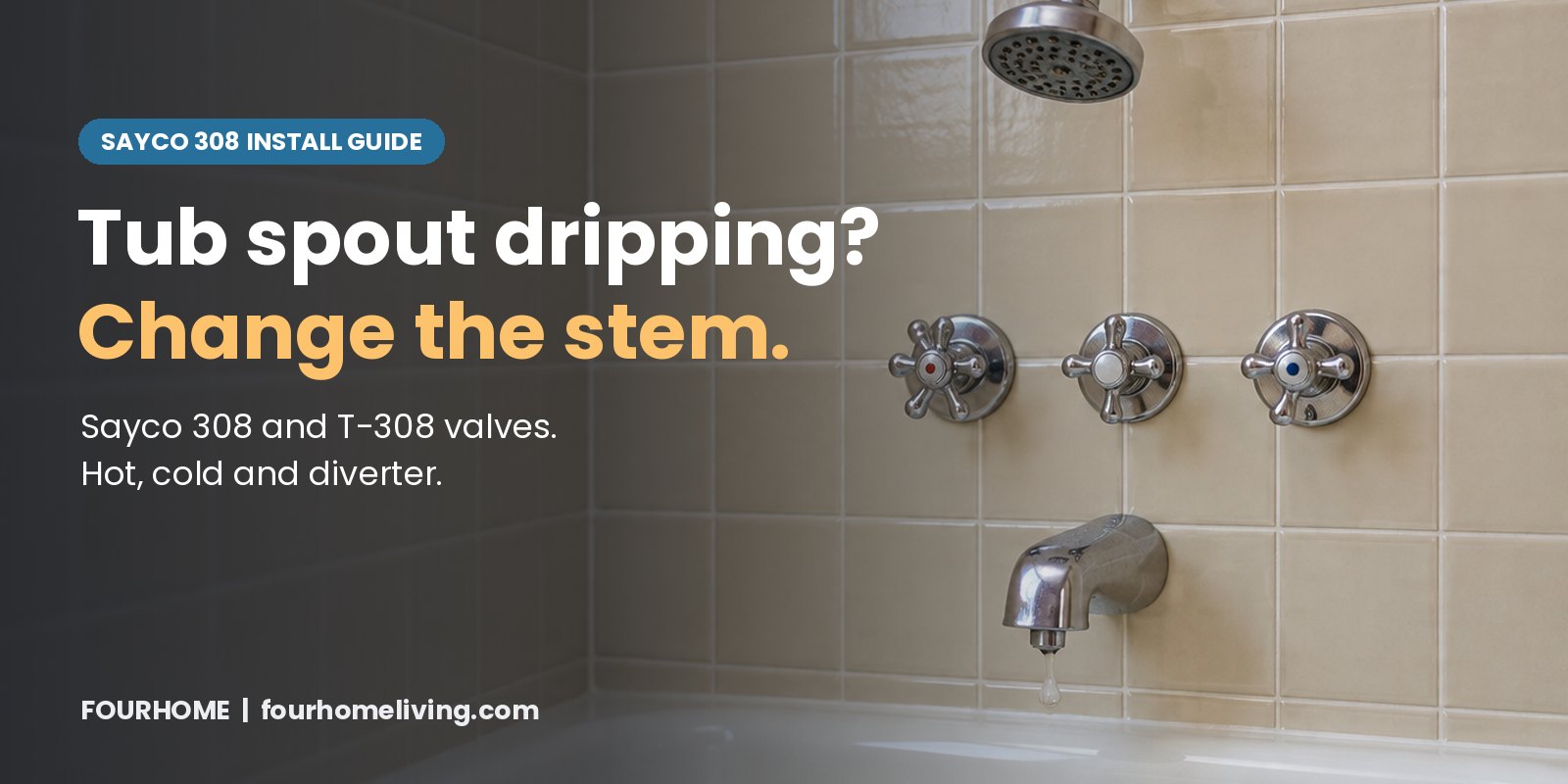
A three-handle tub and shower that drips from the spout can usually be fixed by replacing a stem. Briggs, which lists the Sayco brand today, says the most common leak is a drip from the end of the spout and that it can usually be fixed by replacing the stem or cartridge. The hard part is picking the right stem, because a three-handle valve has three different ones.
This guide does both jobs. It helps you work out which of the three is the problem, and then it walks you through shutting off the water, taking the old stem out and fitting the new one. It also ends with the signs that mean you should put the tools down and call a plumber. One limit up front: no source we found gives the diverter's thread direction, so for the diverter this guide may stop at step 4.
Is it a Sayco 308 or T-308?
Three handles on a tub and shower is the first clue. Briggs still lists the Sayco brand, including a three-handle compression set, the S308, whose spec sheet puts hot water on the left and cold water on the right. Danco and HD Supply list replacement stems for the Sayco bath faucet models 308 and T-308 from 1968. Those are the stems this guide covers.
The Briggs S308C is a different valve. Briggs lists it as a ceramic cartridge valve with lever handles, so compression stems are not for it. If your handles are levers, take a handle off and look before you order anything.
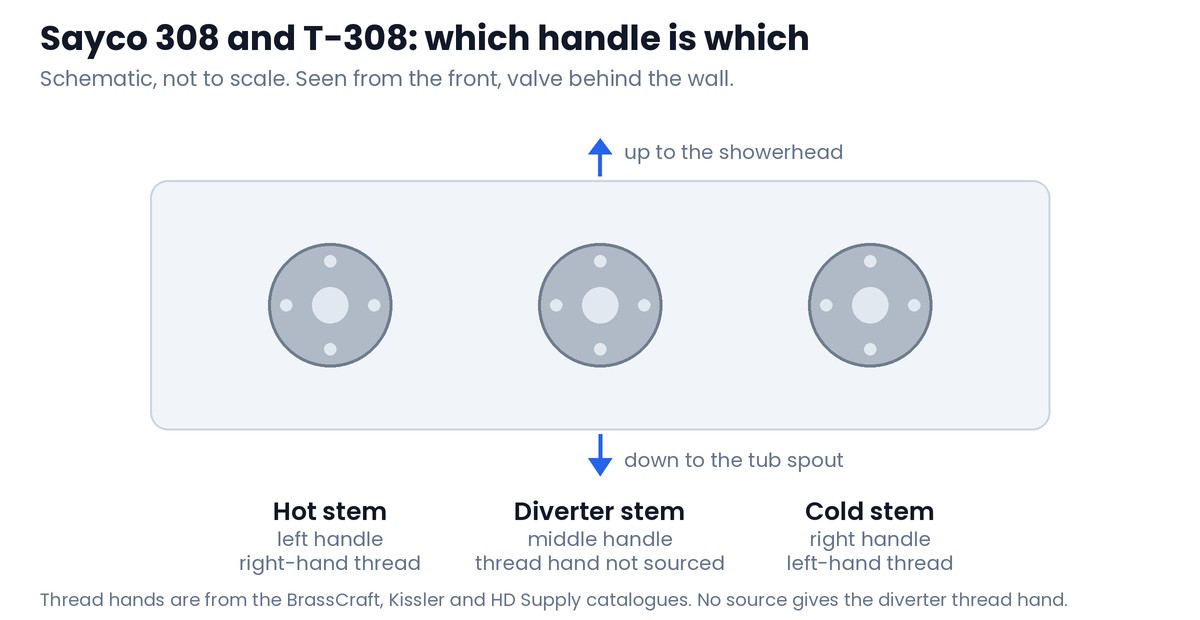
On a 308 or T-308 the left handle controls the hot stem, the right handle controls the cold stem, and the middle handle controls the diverter. Jones Stephens describes the center stem as the one that sends water to the shower or to the tub spout.
Which stem is the problem?
You cannot tell hot from cold by looking at the drip, so test it. Danco gives this test, written for a faucet with supply valves under a sink: shut off the hot water supply and watch the spout. If the drip stops, the hot stem is the one to replace. If it keeps dripping, check the cold stem. This works only if you can shut off the hot supply on its own. If the only shutoff you have turns off the whole house, the drip stops either way and the test tells you nothing; that limit is our reading, and in that case start with the hot valve and repeat on the cold valve if the drip persists, the order Delta's tub and shower article uses; Delta describes repairing each valve in turn, not a drip test. If water leaks from around a handle, that handle's stem is the one.
| What is happening | What to check |
|---|---|
| The spout drips when everything is off | Shut off the hot supply on its own. Drip stops: hot stem. Drip continues: cold stem. If you can only shut off the whole house, skip this test and start with the hot valve. |
| Water leaks from around a handle | The stem under that handle. |
| Water keeps running from the tub spout while the middle handle is set for the shower | The diverter stem. Jones Stephens says the center stem sends water to the shower or to the tub spout. Matching this symptom to the diverter is our reading, not a maker's statement. If a new stem does not fix it, call a plumber. |
Three stems, three different parts
The hot and cold stems look alike, but they are not the same part. Catalogues list the hot stem, P002, with a right-hand thread and the cold stem, P004, with a left-hand thread. BrassCraft marks them P002 RH and P004 LH, Kissler lists a Righthand Hot unit and a Lefthand Cold unit, and HD Supply lists a right-hand hot water stem and a left-hand cold water stem. That is why the cold handle should turn the opposite way from the hot one. One catalogue, Jones Stephens, lists a single stem for either the hot or the cold side and says nothing about thread direction, and we could not reconcile that with the others, so check your own valve before you order. Turn the handle the way that opens it and note the direction: counterclockwise to open points to a right-hand thread, clockwise to open points to a left-hand thread. That reading is ours, not a source's. The diverter is its own part for the middle handle. We did not find a source that gives the diverter's thread direction, so we do not state one.
All three stems use a 16-point broach, which is the splined end the handle slips onto and which the handle screw holds. Danco and BrassCraft list that as a B broach for these Sayco stems. The catalogues do not agree on stem lengths in inches, so we do not print one. Measure your old stem, count the splines on its end, and lay it beside the new stem. BrassCraft says to measure the stem on its length gauge and to count the teeth on the spline.
If you want to look a stem up by part number, our sister site keeps a part number index of Sayco stems.


Shut the water off first. Kissler says the first thing to do is turn off the water supply, at a nearby shutoff if there is one, and at the main shutoff for the whole house if there is not. Delta's article for two or three handle tub and shower faucets starts with the hot valve and says to shut off the hot water supply, and to use the shutoff for the house if you cannot find the shutoff for the valve. Our own rule for taking a stem out is stricter: shut off both the hot and the cold water to the valve, or the whole house at the main shutoff, because a stem that is out leaves an open port. Danco also says to turn off the water supply once you know which stem is the problem. Do not force anything. This is our own rule, not a maker's: none of the sources we read says what to do about a stem that will not turn, and a stem that breaks off could leave the valve with no way to shut off. A stem that will not turn is a reason to stop. Delta says that if you do not have experience with plumbing repairs, it recommends a licensed plumber for tub and shower repairs. BrassCraft's sheets add: do not install the part until you have read and understood all the instructions.
What you need
- The new stem or stems, matched against the old one by broach count and side-by-side comparison.
- A wrench for the stem, and an adjustable wrench or slip-joint pliers for the packing nut. Kissler says to use large slip-joint pliers or an adjustable wrench on the packing nut and to be careful not to scar the metal.
- A flat head screwdriver and a Phillips screwdriver for the handle. Danco lists both, and a seat removal tool as optional.
- Penetrating oil, only for a stuck handle screw or washer screw. Kissler says to use it there.
- A towel, to lay the parts on in the order they came off.
Step by step
Step 1: Shut off the water
Shut off both the hot and the cold water, as above. Then open the hot handle and the cold handle, gently, to see that the water has stopped; a little water may drain out first. Note which way each handle turned to open, because step 4 needs it, and then close both again. If a handle will not turn, do not force it. If water keeps running, stop and call a plumber. Do not turn the water back on while a stem, a packing nut or a handle is off. The check and these rules are ours; none of the sources we read gives them.
Step 2: Take the handle off
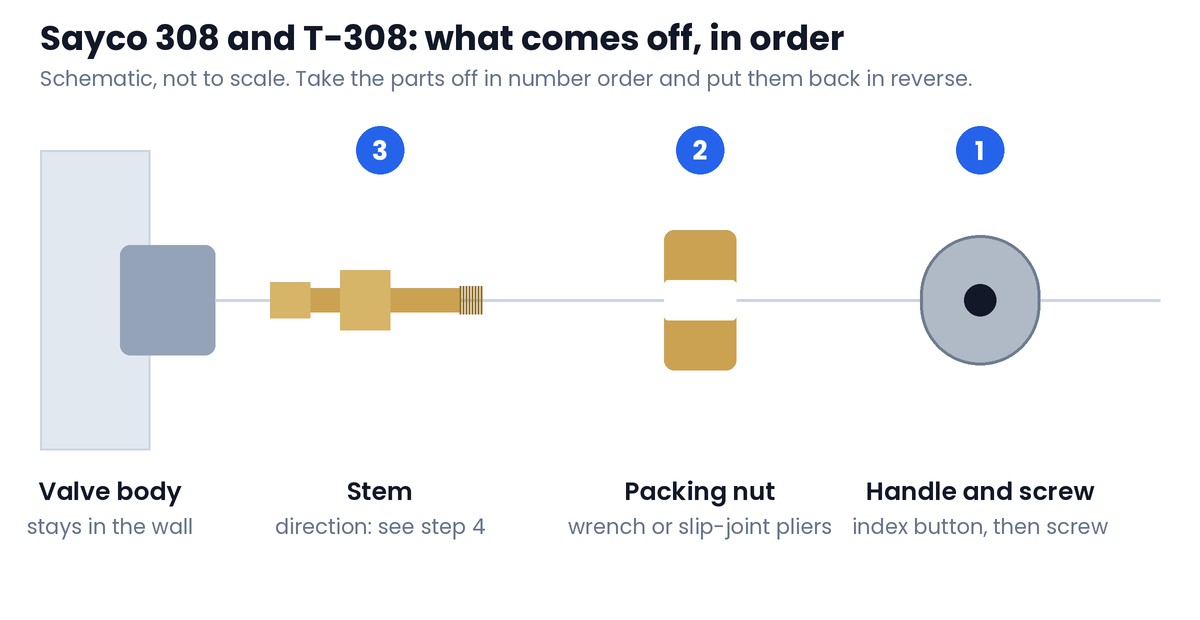
You noted in step 1 which way the hot and cold handles turn to open, and you need that in step 4. For the middle handle, see step 4. Briggs says to remove the index button on the handle, then the screw, and then the handle should come off. BrassCraft says the same: handle cap, retaining screw, and lift the handle off gently. Danco's instructions also mention a set screw on the handle, and say to loosen it by turning it counterclockwise. If the handle screw is stuck, Kissler says penetrating oil can help loosen it.
Step 3: Remove the packing nut
The bonnet, or packing, nut sits over the stem. HD Supply lists a hot stem for the 308 and T-308, and a separate Sayco cold stem, as stem and bonnet, and the FourHome stems pictured above have a hex-shaped body, so on your valve the nut and the stem body may come out together. BrassCraft's parts diagram for the Sayco 308 and 308T lists each stem as one part, with a sleeve over it, and lists no separate nut, but no source we read gives the steps for taking one apart, so look before you turn anything, and stop if what you see does not match this guide. Kissler says to remove the nut with large slip-joint pliers or an adjustable wrench, being careful not to scar the metal. Delta says the same with an adjustable wrench. No source we read says which way the nut turns on a Sayco 308, and we do not assume it turns the same way as the stem. If the nut and the stem body are one piece, treat it as the stem and follow step 4; that is our reading. If it will not turn without force, stop; that is our own rule. If a sleeve or trim covers the nut, take it off following the instructions for your trim. None of the sources we read describes how the sleeve comes off.
Step 4: Back the stem out
Note how the old stem sits, as Briggs says about the cartridge it describes, so the new one goes in the same way. Kissler's wording for taking a stem out is direction-neutral, so it can be used here: twist it out by turning it in the same direction you would to turn the faucet on. For the left-hand cold stem that is the direction that matters, because it is not the usual counterclockwise. The catalogues give a thread hand for the stem, but none says whether the thread that holds the stem's hex body in the valve has the same hand, so put only steady hand pressure on the wrench; if the stem does not start to turn that way, stop and do not try harder in either direction. That caution is ours. Danco's general instructions on its Sayco stem pages say to rotate a brass stem counterclockwise until it threads out. That line is written for an ordinary right-hand thread, which is our reading, so for the cold stem follow the handle rule here instead. For the diverter we found no source for the thread direction, so we cannot tell you which way it comes out. Do not guess and do not force it. If you cannot tell which way it backs out without force, stop and call a plumber. If you stop here, put the packing nut and handle back on the way they came off before any water goes back on, and leave the old stem where it is; if it has already turned part of the way, turn it back the way it moved, without force. That is our own rule, not a maker's. If the stem does not move, stop and see the box above.
Step 5: Compare the old stem with the new one
Lay them side by side. Check the splines on the end, the length by eye, the thread, and what is at the working end. The hot and cold stems have a washer held by a screw at the working end. The diverter in our listing image has open ports and two O-rings near its lower end, and a seat washer at the tip. Kissler says to replace the old washer with an exact replacement, because washers that almost fit will almost stop the drip.
Step 6: Look at the seat
While the stem is out, shine a light into the valve and look at the brass seat the washer closes on. Danco says that if the washer is squeezed flat or has a groove worn in it, a new washer together with a new faucet seat will likely solve the problem. A seat comes out with a faucet seat wrench, as BrassCraft says, or with an Allen wrench or seat removal tool, as Danco says. Sayco seats are a separate part.
Step 7: Fit the new stem
Thread the new stem in by hand first. Go the opposite way from the way the old one came out, which is the direction you would turn the handle to close the valve. That rule gives the right way in for the hot stem and for the left-hand cold stem alike. It is our reading, not a maker's statement: no source we read gives a direction for threading a Sayco stem in. If it resists in the first turn, stop and start again, so the threads do not cross; that caution is ours. BrassCraft's instructions for its lavatory and kitchen compression stem say to hand tighten, then use a wrench to tighten the new stem 1/4 turn, and they add in capitals: do not overtighten. Its rebuild kit sheet says wrench tight and repeats the same warning. We found no BrassCraft sheet written for a tub and shower stem, so these are the closest sources we have. Then put the packing nut back on, being careful not to scar the metal, as Kissler says.
Step 8: Put it back together, and test
Reassemble in the reverse order, handle last. BrassCraft says to replace the handle and secure it with the retaining screw, and Kissler says to reinstall the handle and replace the button or disc. Then turn the water back on and check for leaks, as Kissler and BrassCraft both say. Run the hot, the cold and the diverter in turn, with the handle shut and open.
If the drip does not stop
- The seat may be worn. To check it, shut off both supplies again as in step 1, take the stem out again, and then see step 6.
- The valve is old. Delta says that if your valve is more than about 25 years old, the faucet body itself may have developed a leak, and that you would then replace the tub and shower valve.
- The diverter symptom stays after a new diverter stem. Call a plumber. We found no maker source that explains this symptom for a Sayco valve.
When to stop and call a plumber
These stop signs are our own rules. Delta also recommends a licensed plumber if you do not have experience with plumbing repairs.
- A stem, a nut or a handle will not turn without force. Do not force it.
- You cannot tell which way the diverter stem backs out without force.
- Water does not shut off at the supply, so you cannot work on the valve.
- The handle is gone, the stem is broken, or the valve body is leaking.
- You have changed the stem and the seat and the valve still leaks.
Frequently asked questions
How do I tell which stem is leaking?
Danco gives a test for a faucet with two supply valves: turn off the hot water supply, and if the drip stops, the hot stem is the one to replace; if it keeps dripping, the cold stem is. That works only if you can shut off the hot supply on its own. Delta's article for a two or three handle tub and shower starts with the hot valve: it says to shut off the hot water supply and work on the hot valve, and to repeat the steps on the cold valve if the drip persists. Danco also says that if water leaks from under a handle, the stem of the handle that is leaking needs to be replaced.
Why does the cold stem turn the other way?
Catalogues list the Sayco hot stem, P002, with a right-hand thread and the cold stem, P004, with a left-hand thread. BrassCraft marks them P002 RH and P004 LH, Kissler calls its two Sayco units Righthand Hot and Lefthand Cold, and HD Supply lists a right-hand hot water stem and a left-hand cold water stem. A left-hand thread tightens the opposite way from an ordinary one, so the cold handle should turn the opposite way from the hot handle to open, and, by our reading, the cold stem's spindle turns the opposite way from the hot stem's; no source says whether the thread that holds the stem body in the valve is also left-hand, so if the stem will not turn without force, stop. One catalogue, Jones Stephens, lists a single stem for either the hot or the cold side and says nothing about thread direction, and we could not reconcile that with the others. We did not find any source that states the diverter thread direction.
Will these stems fit the Briggs S308C?
No. Briggs lists the S308C as a ceramic cartridge valve with lever handles, and the stems in this guide are compression stems for the 308 and T-308. Briggs also lists a three-handle S308 and S308L with compression cartridges today, and we have not checked whether their stems match, so measure and compare before you order.
Do I need to replace the seat as well?
Look at the old washer. Danco says that if it is squeezed flat or has a groove worn in it, a new washer together with a new faucet seat will likely solve the problem. Danco says the seat comes out with an Allen wrench or a seat removal tool, counterclockwise to loosen and clockwise to tighten, and BrassCraft says to use a faucet seat wrench.
What if the stem will not turn?
Stop. None of the catalogue or maker pages we read says what to do with a stem that will not turn, so this is our rule: do not force it. A stuck stem could break and leave the valve with no way to shut off. Delta says that if you do not have experience with plumbing repairs, it recommends a licensed plumber for tub and shower repairs.
Sources
The steps above come from these pages, except where a step says the advice is our own. We opened each one on October 6, 2026, and checked them again on October 12, 2026.
- Briggs Plumbing, S308 three handle tub and shower, S308 spec sheet, S308C and Help Center.
- Danco, 9B-3H Hot Stem for Sayco Faucets, 9B-3C Cold Stem and 9B-5D Diverter Stem.
- BrassCraft, Service Parts Catalog SP-0341, Stems/Cartridges by Length, Faucet Explosions and installation instructions 525.15, Compression Faucet Stem (11/19) and installation instructions 525.614, Faucet Rebuild Kit (11/19).
- Kissler, 23-3162H Sayco Righthand Hot, 23-3162C Sayco Lefthand Cold and How to Fix a Leaky Faucet (Compression-Type Faucet Repair).
- HD Supply, stem and bonnet for Sayco, hot, faucet stem cold for Sayco, 16-point and stem and bonnet for Sayco, cold.
- Jones Stephens, C07326 hot or cold tub and shower stem and C07417 diverter tub and shower stem.
- Delta, Dripping two-handle or three-handle tub and shower faucet spout.
Replacement stems, cartridges, seats and springs for Sayco, Moen, Delta, Kohler, Pfister, Glacier Bay and more, shipped from Amazon fulfillment centers with Prime delivery.
See the full FourHome assortment on AmazonFourHome is an independent brand and is not affiliated with Briggs Plumbing, Sayco, Danco, BrassCraft, Kissler, HD Supply, Jones Stephens or Delta Faucet Company. Brand names and part numbers are used only to identify compatibility or to cite their published instructions. Follow the instructions that came with your valve, do not force a stem or a nut, and call a licensed plumber if the water will not shut off or the valve leaks.
FourHome is not affiliated with or endorsed by any faucet manufacturer. Brand names and part numbers are used only to identify compatibility.