How to Replace a Pop-Up Sink Stopper (Pivot Rod Drains)
A bathroom sink that will not hold water, or that drains with the stopper closed, may not need a new faucet or a new drain. Danco describes a new pop-up stopper as an easy and inexpensive alternative to replacing the entire drain assembly. Moen adds the other side of it: drains also fail from rust or a worn rubber gasket, so it pays to look at what you have before you buy.
This guide is for one job. It identifies a pivot rod drain, frees the old stopper at the nut, fits the new one, sets the lift and tests the seal. It does not cover taking the whole drain apart, and it ends with the signs that mean you should stop and call a plumber.
Is this your drain?
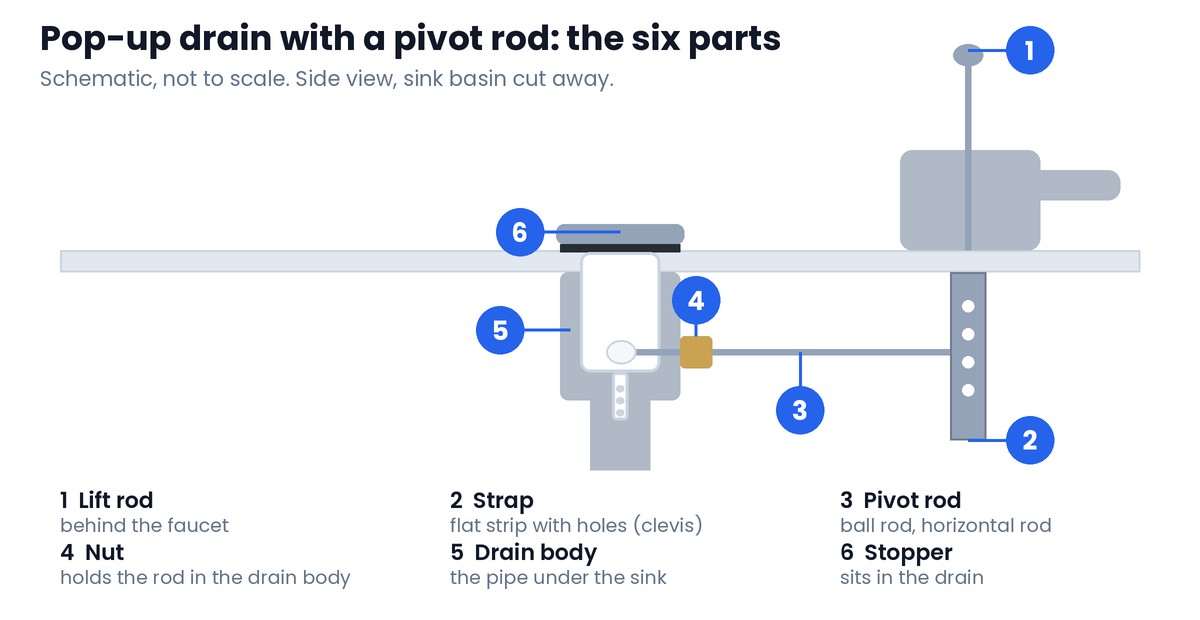
Look behind the faucet and under the sink. A pivot rod drain has a lift rod behind the faucet, and behind the drain pipe under the sink a horizontal rod, held by a nut, that joins the lift rod through a flat strap with holes. Delta describes the drain that way, and Pfister, Kohler and Danco describe the same linkage. The diagram names each part once, with the other names the makers use.
Some drains look the same from above and work differently. Delta describes sink stoppers that push down to seal and push down again to open, and says that if one does not pull straight out you can rotate it a quarter turn and lift. Moen makes push-down drains and grid drains, Pfister makes Push & Seal drains, and Kohler makes a clicker drain, where the instructions say never to pull on the cap. None of those has a pivot rod. If that is your drain, this guide does not apply, and the instructions that came with it are the ones to follow.
If you are not sure the stopper is the cause, our sister site has a short troubleshooter that asks a few questions while you fill the sink: bathroom sink stopper won't hold water.
Close the faucet and the shutoff valves under the sink before you begin. Pfister and Moen both put shutting off the water first when a whole drain is replaced. None of the pages we read says it for a stopper alone, so this one is our own caution. Do not force anything. If the stopper will not come out when the nut is off and the rod is pulled back, Delta says you may have an unusual drain assembly and that more detail about the faucet age, brand and model may be needed. That is the point to stop and ask a plumber. Keep harsh chemicals out of it: Pfister says to clean with warm water and a mild cleaner or vinegar solution.
What you need
- The new stopper. Measure the old one when it is out, as step 1 explains.
- An adjustable wrench or pliers, in case the pivot nut is stiff. Pfister's instructions use an adjustable wrench for the nut.
- Plumber's grease, if you want it. Pfister says to lubricate moving parts with plumber's grease.
- A rag, and a ruler for the old stopper.
Step by step
Step 1: Measure the old stopper
Makers do not agree on a single stopper size. Danco sells separate stoppers for Delta, Moen and American Standard drains at different sizes, and Kissler prints its own size for each brand, which is not always the same as Danco's. The sizes below belong to the parts named, not to every drain of that brand. Measure the old stopper, its length and the width of its top, once it is out in step 3, and compare it with the table before you fit a new one.
| Stopper | Height | Top diameter | Source |
|---|---|---|---|
| Danco universal, 80418X | 4-1/2 in. | 1-3/8 in. | Danco |
| Danco for Delta, 88057X | 5 in. | 1-3/8 in. | Danco |
| Danco for Moen, 88994 | 4-1/2 in. | 1 in. | Danco |
| FourHome pop-up stopper, 5 pack | 5 in. | 1-3/8 in. | Our listing |
Step 2: Shut off the water and open the stopper
Close the shutoff valves under the sink and close the faucet. Then lower the lift rod behind the faucet so the stopper is open and any water in the basin can drain, which is where Pfister starts its own drain check.
Step 3: Free the old stopper
Some stoppers simply lift out, and others are held in by the pivot rod, so try lifting first. If it stays put, go under the sink. Unscrew the nut that holds the rod to the drain body, turning it counterclockwise as Pfister says. Then pull the horizontal rod straight back from the pipe about an inch, as Delta says, and the stopper should come free of the drain. Kohler gives the same sequence: nut off, rod out, stopper out. Now measure the old stopper, as step 1 says, before you go on.
Leave the lift rod and the strap where they are. You are only backing the rod out of the drain body. No maker says the clip has to come off to back the rod out an inch, so this part is our own reading. If the rod will not slide back because of the spring clip that holds it to the strap, Kohler's adjusting instructions remove the clip by squeezing its ends together, and Pfister's instructions say to mark the hole the rod passes through before you take the rod out of the strap. If the stopper still will not come out, stop and see the box above. If you stop at this point, put the rod and nut back before you open the shutoff valves or run the faucet, because Pfister says to reinstall the ball rod first to keep water from leaking out of that area.
Step 4: Clean it, and look at the rod
While the stopper is out, remove hair and debris from the stopper and from around the opening in the drain, and wipe the O-ring if the old stopper has one, as Pfister says. Look into the drain for debris stuck in the pop-up assembly. If you cannot see anything and the sink still drains badly, Pfister says you may need to call a licensed professional to check your drains for a clog.
Then look at the pivot rod. Moen says a rusted pivot rod end can make a stopper stick in the drain. A rod that is bent, rusty or pitted is worth replacing now, while it is out. A straight clean rod can go back in.

Step 5: Fit the new stopper
Set the new stopper in the drain with a hole at its foot lined up with the opening in the side of the drain body, as Pfister shows. The FourHome stopper has a row of holes in the flat strip at its foot, and the pivot rod passes through one of them. Our listing says the hole you use sets how high the stopper sits, so if it does not seal or does not open far enough, step 7 explains how to change it. Check that the washer sits firmly on the end of the ball. Pfister says to lubricate moving parts with plumber's grease, and a thin coat on the ball at this point is our own suggestion. Then thread the rod through the hole and push it back into the drain body. If your old stopper lifted out without the nut coming off, the rod is still in the drain body, so undo the nut and back the rod out about an inch first, as in step 3, so that it can pass through the hole. That is our own reading. If you took the spring clip off in step 3, put the rod back through the same hole of the strap and refit the clip, because Pfister says to make sure the clip is back on so the rod cannot come loose. Wiggle the pivot rod up and down to see that the stopper moves, which Pfister says shows that you caught it.
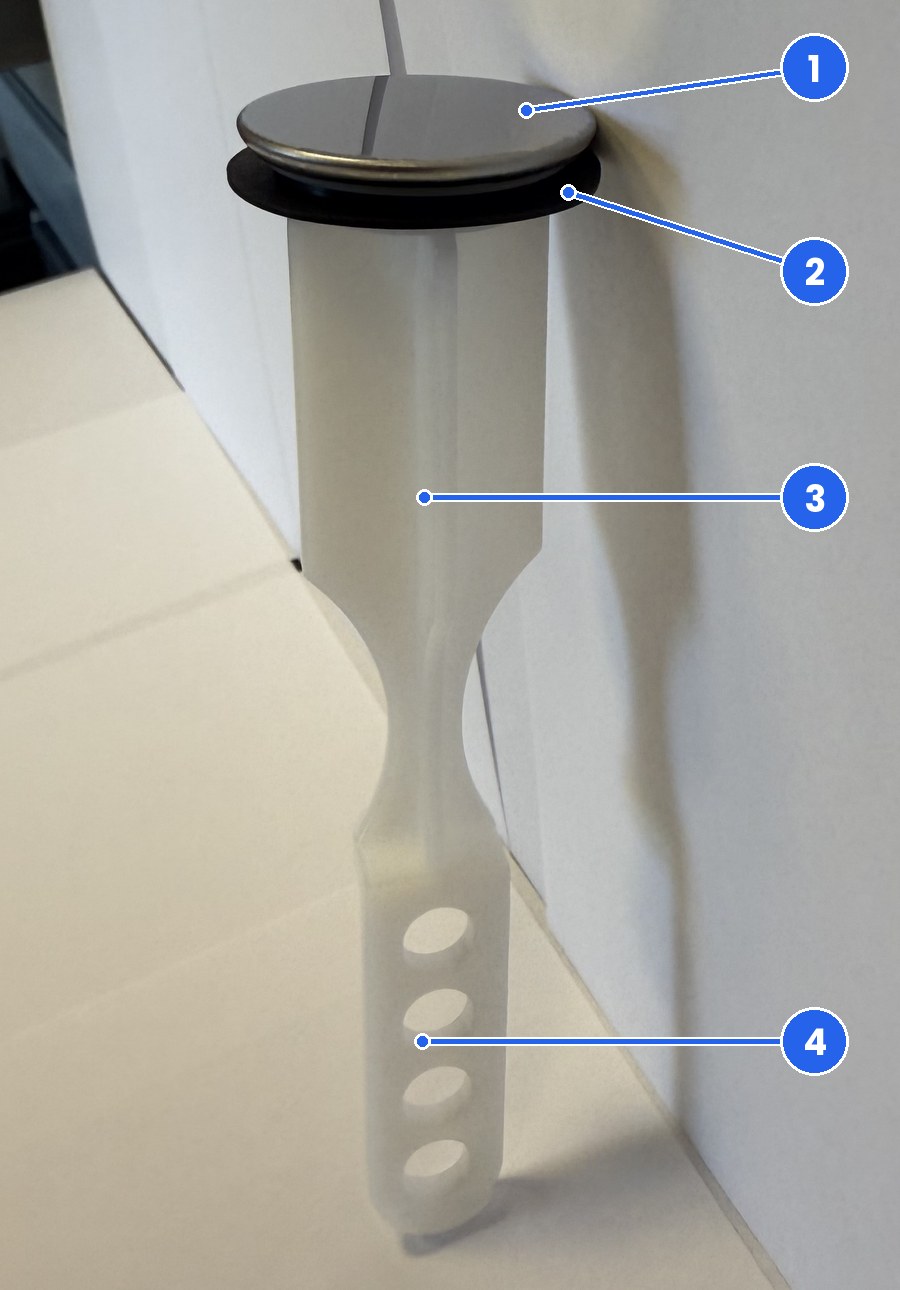
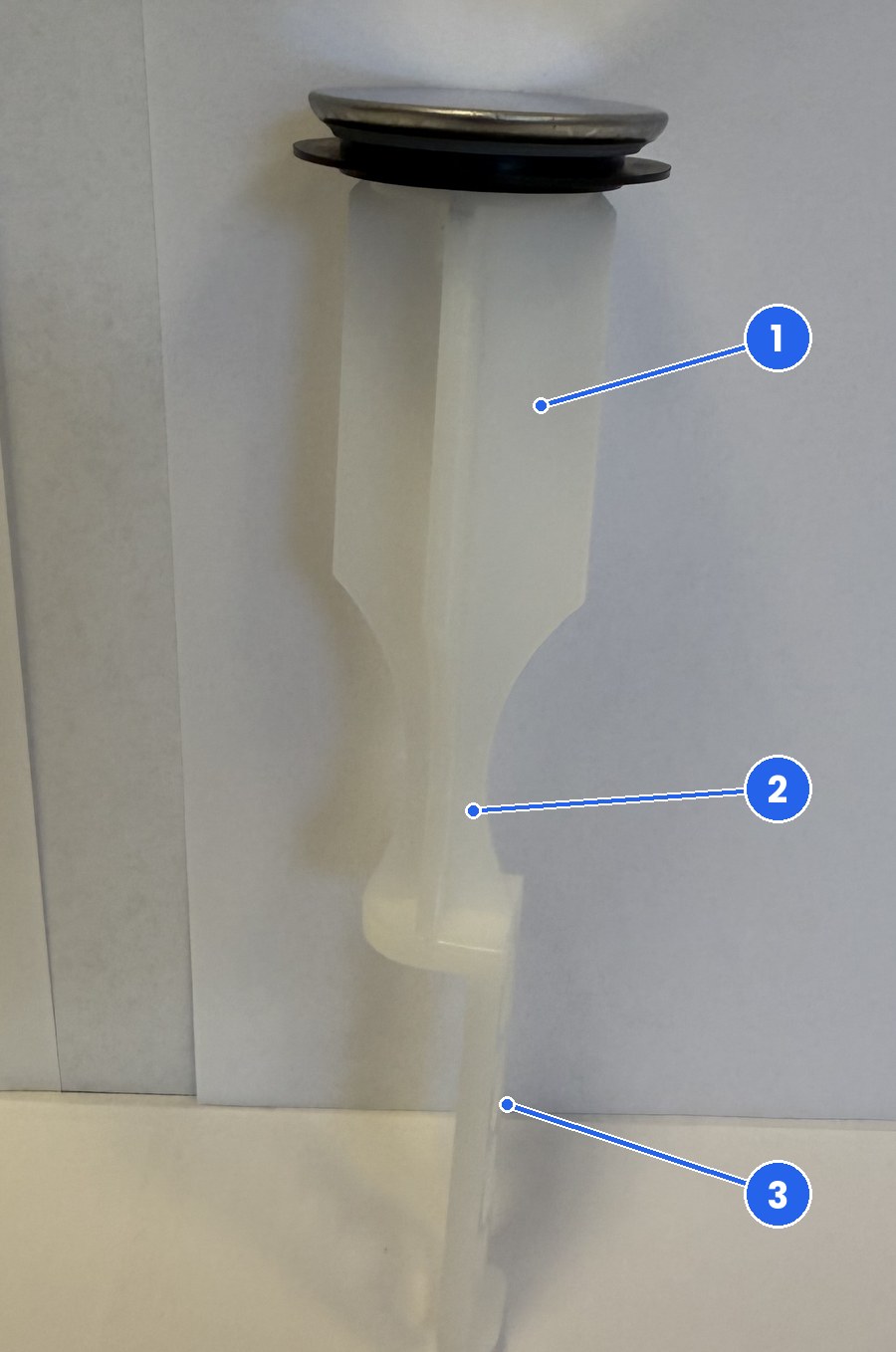
Moen and Delta both describe two ways to set the rod. It can pass through the stopper, which keeps the stopper from lifting out afterward, or it can sit beside the stopper so the stopper comes out for cleaning. With this stopper the rod goes through a hole, so cleaning it later means undoing the nut again.

Step 6: Tighten the nut
Thread the nut on and tighten it by hand until it stops. Delta says to hand tighten it and, when you check for leaks, not to overtighten. Pfister goes a little further and says to turn the nut clockwise until it stops and then give it a quarter turn with an adjustable wrench. Like Delta, Moen says hand tight for a plastic nut, so start by hand and add more only if the nut weeps in step 8.
Step 7: Set the lift at the strap
The makers set the lift at the strap. Pfister, Moen and Kohler all do it there. Moen puts the lift rod down at rest and the rod clip on the lowest hole of the strap to start, and Kohler says to move the linkage up or down to a different hole to adjust how the stopper moves. Pfister recommends at least 1/4 to 1/2 inch of lift for good drainage, and says that moving the rod to a higher hole may help the stopper close more tightly. On a stopper with a row of holes, like ours, the hole the rod passes through also sets how high the stopper sits, which is how our listing describes it. If moving the rod at the strap does not give you a good seal and a good opening, undo the nut, back the rod out as in step 3, move it to another hole on the stopper, try it, and tighten the nut by hand again.
Step 8: Test it
Open the shutoff valves again. Pull the lift rod all the way up to close the stopper, as Pfister says, and fill the basin. If the water holds, open the stopper and check that it drains. Then check the nut under the sink for a weep, and tighten a little only if you need to, never past what you can do without forcing it. A weep at the nut can mean the nut is loose or the washer is not seated on the ball, which is Pfister's advice to confirm that gaskets and washers are seated and tightened.
If it still does not work
| What you see | What the makers say | What to try |
|---|---|---|
| The stopper closes but the water slowly drains | Pfister says to make sure the stopper cap is fully threaded to the body, and to wipe the O-ring. | Wipe the rubber ring under the cap. If your cap unscrews, check that it is fully threaded on, and do not force it if it does not turn. Then try a higher hole at the strap, as Pfister suggests. |
| The sink drains slowly with the stopper open | Pfister recommends at least 1/4 to 1/2 inch of lift. | Lower the lift rod fully, then move the rod to a different hole at the strap, as Kohler describes, and test again. |
| A weep at the nut | Pfister: confirm gaskets and washers are seated and tightened. | Check that the washer sits on the ball, and tighten the nut a little by hand. |
| The stopper sticks in the drain | Moen: in some cases a rusted pivot rod end can make the stopper stick. | Look at the rod end. If it is rusted, replace the pivot rod. |
When to stop and call a plumber
Whichever of these stops you, put the rod and nut back before you open the shutoff valves or run the faucet, because Pfister says to reinstall the ball rod first to keep water from leaking out of that area.
- The stopper will not come out with the nut off and the rod pulled back. Delta says you may have an unusual drain assembly. Put the rod and nut back before you open the shutoff valves.
- You cannot see debris, but the sink still drains slowly. Pfister says you may need a licensed professional to check your drains for a clog.
- The drain body itself leaks, or is rusted. Moen says drains sometimes need replacing because of rust or an eroded rubber gasket. Pfister says a whole drain comes out with the water off and the P-trap disconnected, which is more than a stopper swap.
- The drain is a push-down, Push & Seal, clicker or grid drain. Follow the instructions for that drain.
Frequently asked questions
How do I know my sink has a pivot rod drain?
Delta describes it this way: most sink drain plugs are worked by a lift rod behind the faucet, and behind the drain pipe under the sink is a horizontal rod, held in place by a nut, that is connected to the lift rod by a strap. If you can see that rod and nut under the sink, you have the type this guide covers. Some newer drains push down to seal and push down again to open, and Moen, Pfister and Kohler all make drains that work that way or by a clicker. Those have no pivot rod, so follow the instructions that came with your drain.
Which way does the lift rod go to close the drain?
Pfister says to pull the pop-up rod on the back of the faucet all the way up to close the stopper, and to lower it to open the stopper so water can drain.
Will this stopper fit my sink?
Measure your old stopper first. Makers list stoppers by brand and size. Danco lists its universal stopper 80418X at 4-1/2 inches high with a 1-3/8 inch top, its stopper for Delta at 5 inches by 1-3/8 inches and its stopper for Moen at 4-1/2 inches by 1 inch. Those are the sizes Danco gives for its own parts, and Kissler lists other sizes for stoppers made for the same brands. Pfister says many bathroom sinks use a 1-1/4 inch drain opening, and the word is many, not all. The FourHome stopper is 5 inches long with a 1-3/8 inch cap and is made for drains worked by a pivot rod and a lift rod. If your old stopper is a different length or a different width, look for the one that matches.
Do I have to shut off the water to change a stopper?
None of the maker pages we read says either way for a stopper on its own. Pfister and Moen tell you to shut the water off when you replace a whole drain assembly. Changing a stopper does not open a water line, so this is our own caution rather than a maker rule: close the faucet and the shutoff valves under the sink first, and open them again when you test in step 8.
Do I need a new pivot rod as well?
Look at the end of the old one. Moen notes that a rusted pivot rod end can make the stopper stick in the drain, and Danco calls replacing the rod an easy and inexpensive alternative to replacing the entire drain. If the rod is straight, clean and free of rust, you can reuse it.
Sources
The steps above come from these pages, except where a step says the advice is our own. We opened each one on October 6, 2026, and checked them again on October 12, 2026.
- Danco, Universal Bathroom Pop-Up Stopper in Chrome, 80418X, 80418P, stopper for Delta, 88057X, stopper for Moen, 88994, stopper for American Standard, 80379 and Universal Bathroom Pull Rod Assembly, 88532.
- Danco press release, Pop-up Stopper Drain Guide (July 15, 2022).
- Pfister, My pop up drain is not draining water and FAQs.
- Delta, Removing a bathroom sink drain stopper for cleaning and maintenance and installation sheet 107687 Rev H.
- Moen, Bathroom Faucet Drains: Nonmetallic, All Metal, Push Down and Drain Replacement Help.
- Kohler, Adjusting Pop-Up Drains and Pop-up Clicker Drain Installation and User Guide, 7124W-A.
- Kissler, Catalog 2024, Sink, Tub and Drain Repair pages (stoppers listed by brand and size).
Pop-up stoppers, pivot rods and drain parts, plus replacement cartridges, stems and seats for Moen, Delta, Kohler, Pfister, Glacier Bay and more, shipped from Amazon fulfillment centers with Prime delivery.
See the full FourHome assortment on AmazonFourHome is an independent brand and is not affiliated with Danco, Delta Faucet Company, Moen Incorporated, Kohler Co., Pfister or Kissler. Brand names and part numbers are used only to identify sizes or to cite their published instructions. Follow the instructions that came with your drain, do not force a stopper or a nut, and call a licensed plumber for anything beyond a stopper swap.
FourHome is not affiliated with or endorsed by any faucet manufacturer. Brand names and part numbers are used only to identify compatibility.