How to Replace a Faucet Seat (Bibb Seat) in a Compression Faucet
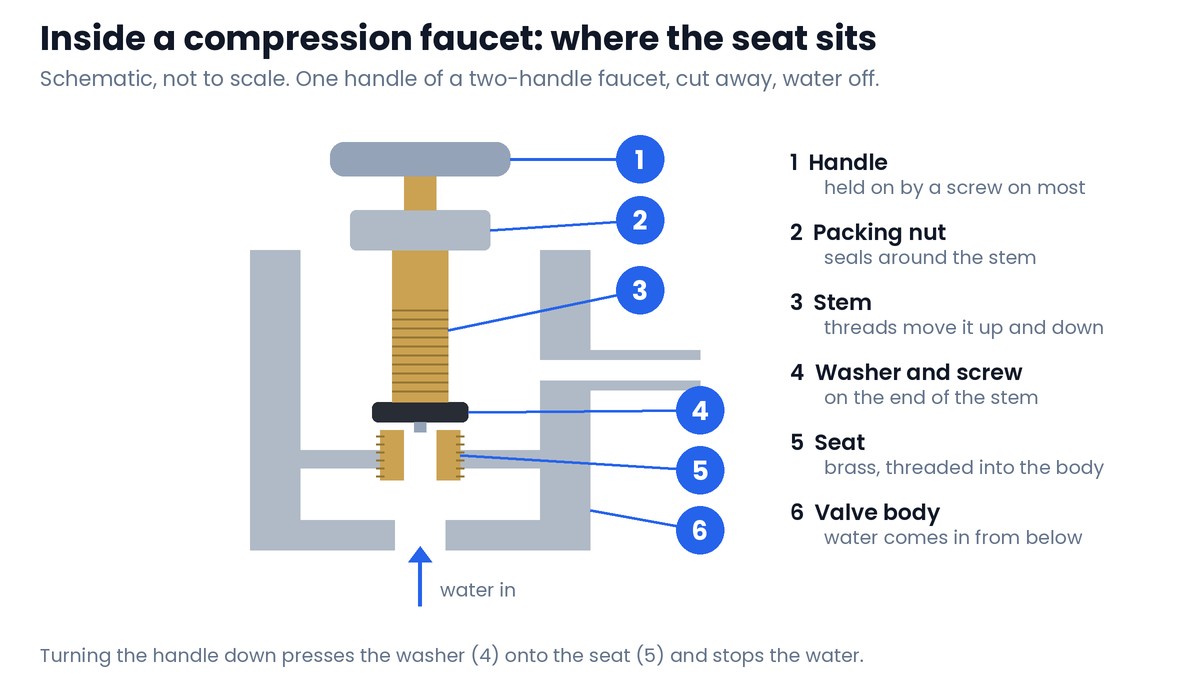
A compression faucet, often an older two-handle faucet, shuts the water off with a rubber washer on the end of each stem, pressed down onto a brass seat inside the faucet body. Bob Vila describes a compression faucet as one that holds back the water with a small rubber washer that tightens in the valve seat. When either part wears, the faucet drips. A USDA plumbing bulletin puts the test simply: moderate force on the handle of a faucet in good repair should stop all flow and drip.
The washer gets the attention, but the seat is the other half of the seal. This guide shows where the seat sits, how to tell which seat you have, and how to take the old one out and fit a new one. If you want the whole faucet explained first, our sister site has a plain guide to how a compression faucet works.
Is this your faucet?
This guide is for compression faucets: faucets whose stems end in a rubber washer that closes against a seat. You can only be sure once a stem is out, because This Old House shows the washer screwed to the bottom end of the stem. If the stem or cartridge you pull has no washer on its end, this guide is not for your faucet.
Shut off the water to the faucet before you take anything apart. The Home Depot says to turn the shut-off under the sink to off and then confirm the water is off by turning the faucet on, and the USDA bulletin starts the same way. For a tub and shower valve, one replacement stem instruction sheet says to turn off the main water supply. Do not force a stem or a seat. Hunker warns that too much torque on the seat wrench can strip the hole in the seat, and a seat that will not come out is the point to stop and ask a plumber, which is our own advice.
What you need
- A seat wrench. BrassCraft sells seat wrenches with hex and square keys, and the key has to fit the socket in your seat snugly, as The Home Depot says.
- A screwdriver for the handle screw, and an adjustable wrench or pliers for the stem. Danco lists a seat wrench, an adjustable wrench and a screwdriver as the tools for its faucet kit. For a stem set deep in a tub and shower wall, This Old House uses a valve socket and pliers.
- Penetrating oil or spray lubricant, in case the old seat is stuck, and a clean rag.
- New seats and a new washer that matches the old one. Our seat 10 packs do not include washers, a seat wrench or thread sealant.
- A seat dressing tool, if you would rather resurface the old seat. BrassCraft makes a faucet reseating tool with reversible cutters.
Step by step
Step 1: Shut off the water
Close the shut-off that feeds the faucet, then open the faucet to confirm the water is off, as The Home Depot says.
Step 2: Take off the handle
The Home Depot says to unscrew the screw that holds the handle in place, and that if there is no screw, you can likely pop the handle off. This Old House turns the screw counterclockwise.
Step 3: Take out the stem
The Home Depot loosens and removes the stem with water pump pliers, and This Old House uses an adjustable wrench to loosen it from the faucet body. In a tub and shower wall the stem sits deeper, and This Old House uses a valve socket and pliers to get it out. On a Sayco 308 valve the hot and cold stems are listed with opposite thread hands, so their handles should turn opposite ways, which our Sayco 308 stem guide explains. If a stem does not move, stop and check before you lean on it.
Step 4: Look at the seat
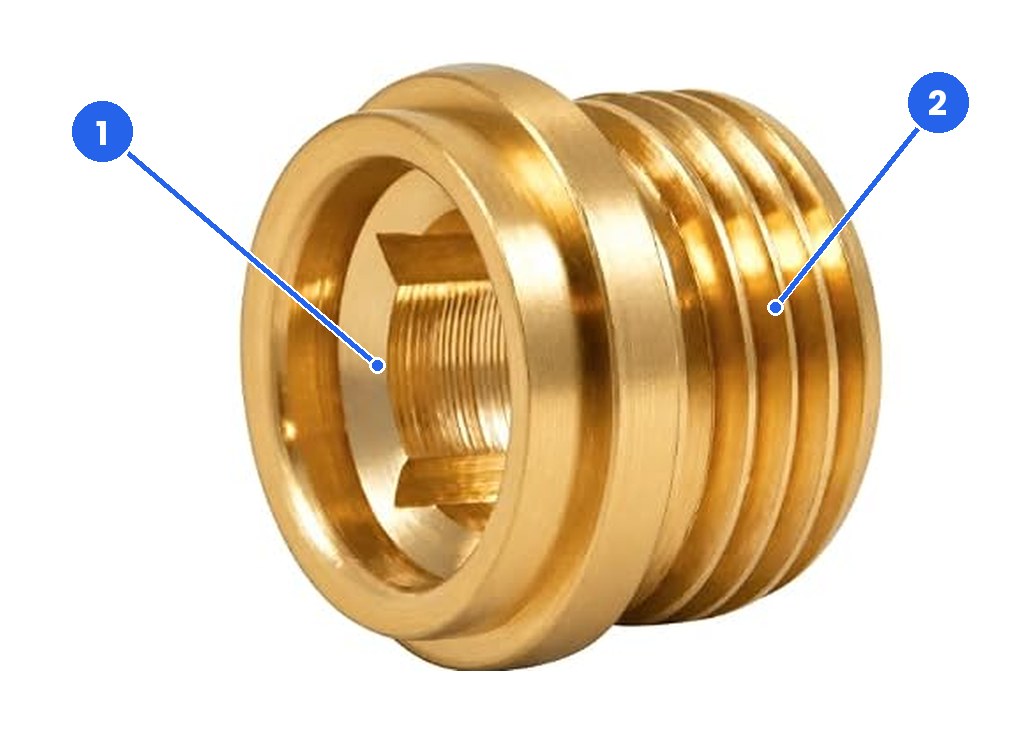
With the stem out, look down into the faucet body. The seat is the short brass insert at the bottom, with a shaped hole in the middle. The USDA bulletin explains that a worn washer leaking constantly over the seat lets grit cut and groove it. This Old House says you can dress a worn seat with emery cloth or a seat redressing tool, and to replace it with a new seat if you cannot repair it. In a tub and shower valve, This Old House advises replacing the seat along with the stem, because skipping this step can mean your new stem wears out faster.
Step 5: Take out the old seat
Pick the key on the seat wrench that fits snugly in the seat and turn it counterclockwise. The Home Depot and the Danco instruction sheet both turn the old seat out counterclockwise. If it will not move, The Home Depot says to apply penetrating oil or spray lubricant, wait a few minutes and try again. Do not lean on it: Hunker warns that too much torque can strip the hole in the seat. The Home Depot also notes that not all seats are removable. If yours is not, it says to resurface the seat by sanding or grinding it down instead of replacing it.
Step 6: Identify the seat, then clean the pocket
Measure the old seat before you buy, as the next section explains. The Home Depot says you likely need to take the old seat with you to pick up the exact same one, and Bob Vila also says to take the old parts to the hardware store. Then clean any residue or debris out of the empty pocket with a clean rag, as The Home Depot says.
Step 7: Fit the new seat
Set the new seat with the seat wrench. The Home Depot says to turn the wrench firmly clockwise and warns: do not over tighten the new valve seat, or you risk damaging the threads. Sources split on thread sealant. This Old House brushes pipe-thread sealant onto the threads of a new shower stem seat, while The Home Depot guide and the Danco sheet do not mention it. See the questions at the end.
Step 8: New washer, then put it back together
This Old House unscrews the rubber washer from the bottom end of the stem and installs a new one, and The Home Depot says to replace the O-rings, washers and bib screws if they show even minor damage. If you dressed the old seat instead of replacing it, The Home Depot says to flush any ground-off debris out of the system first. Reassemble the parts in the same order you removed them, turn the water back on and check for leaks, as The Home Depot says. For a tub and shower stem, This Old House hand tightens the stem into the valve body first and then tightens it with the valve socket and pliers.
Which seat do you have?
Seats are sold by four numbers: the thread diameter, the threads per inch, the height and the width of the face. Danco lists every seat that way, and the Kissler catalog lists each one by height and thread. The thread alone is not enough. Danco lists 1/2 x 20 seats at three heights for three brands, and Kissler lists 1/2 x 24 seats at more than ten heights. So measure all four on the seat that came out of your faucet.
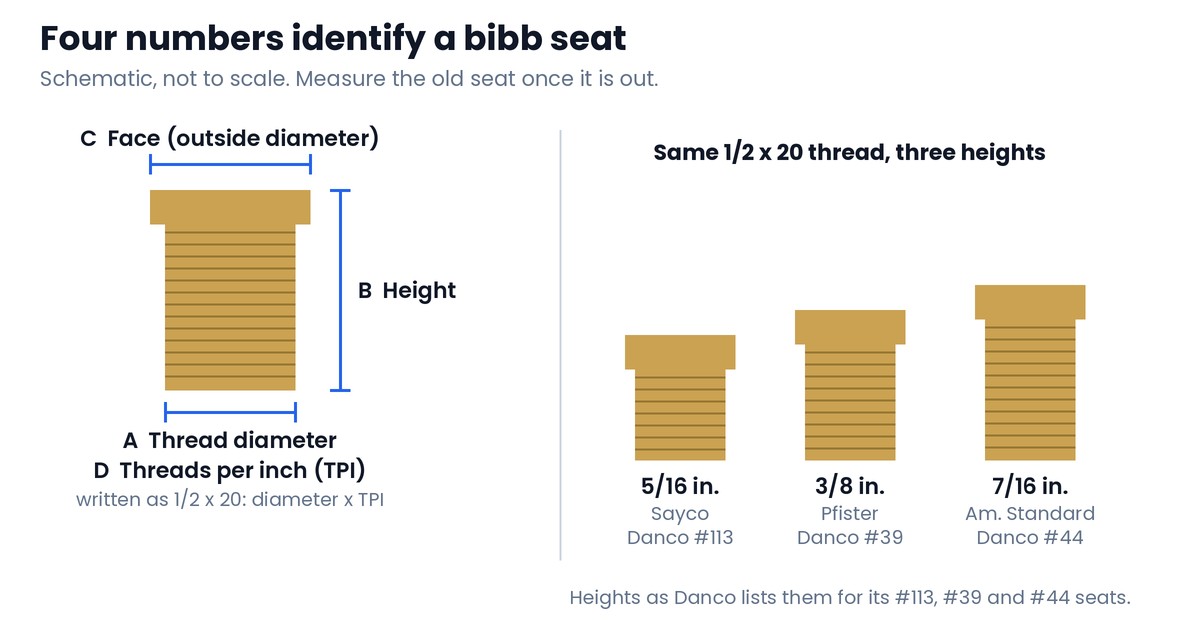
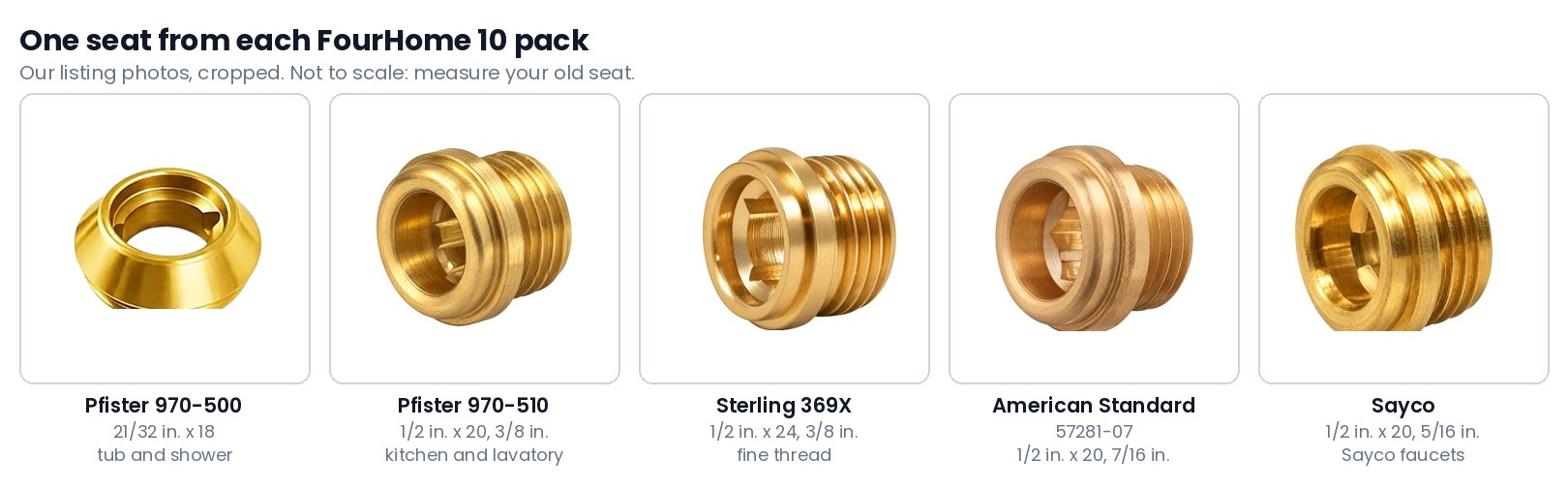
The table lists the seats we sell, with the sizes Danco lists for its seat of the same brand and thread. Check your old seat against the whole row.
| Seat it replaces | Thread | Height | Face | Where it goes | FourHome 10 pack |
|---|---|---|---|---|---|
| Pfister 970-500 (old 5713) | 21/32 x 18 | 3/8 in. | 3/4 in. | Pfister two- and three-handle tub and shower valves | Pfister 970-500 seats |
| Pfister 970-510 | 1/2 x 20 | 3/8 in. | 9/16 in. | Pfister kitchen and lavatory faucets | Pfister 970-510 seats |
| Sterling 369X | 1/2 x 24 | 3/8 in. | 9/16 in. | Sterling faucets | Sterling 369X seats |
| American Standard 57281-07 | 1/2 x 20 | 7/16 in. | 9/16 in. | American Standard faucets | American Standard seats |
| Sayco, 5/16 in. tall | 1/2 x 20 | 5/16 in. | 9/16 in. | Sayco faucets | Sayco seats |
Sizes from Danco: #38 for Pfister 970-500, #39 for the Pfister 1/2 x 20 seat, #18 for Sterling 369X, #44 for American Standard 57281-07 and #113 for Sayco, which Danco lists as replacing the Sayco 6F (new) seat. Danco's #113 page gives the height as 5/16 inch in its description and a different number in its spec table; Plumbers Stock and the Kissler catalog both list the Sayco 1/2 x 20 seat at 5/16 inch. Where it goes: HD Supply for the 970-500 seat, Ferguson for the 970-510 seat.
Look-alikes to rule out
Each of these has the same thread as one of the seats above, or a number that is easy to mix up, but a different size.
| If yours is | It may be | Thread | Height | Face |
|---|---|---|---|---|
| A Sayco seat, 3/8 in. tall | Danco #27, for Sayco 6F (old) | 1/2 x 20 | 3/8 in. | 9/16 in. |
| A 1/2 x 24 seat with a wider face | Danco #7, for Central Brass | 1/2 x 24 | 15/32 in. | 5/8 in. |
| A short 1/2 x 24 seat | Danco #79, for Streamway | 1/2 x 24 | 11/32 in. | 1/2 in. |
| An American Standard seat with a finer, smaller thread | Danco #20, for American Standard | 7/16 x 24 | 13/32 in. | 9/16 in. |
Sizes from the Danco pages for #7, #79 and #20, and from HD Supply's listing of Danco #27. The Kissler catalog also lists an American Standard 1/2 x 20 seat at 3/8 inch tall as well as the 7/16 inch one, so measure the height of an American Standard seat too.
The Pfister 970-500 and 970-510 seats are different sizes, so do not go by the part number alone. Ferguson lists the Pfister 970-500 seat as 21/32 x 18 for tub and shower valves and the 970-510 seat as 1/2 x 20 for kitchen and lavatory faucets. Measure the seat in your hand and match the thread and height.


When to stop and call a plumber
Each of these is our own advice, not a maker rule.
- The seat will not turn after penetrating oil and a second try, or the socket in the seat starts to round out.
- The stem will not come out of the faucet body, or the faucet body moves when you turn the stem.
- The faucet still drips with a new washer on a new or freshly dressed seat.
- Water leaks from the faucet body or the supply lines, not only from the spout.
Frequently asked questions
Do I need a new seat, or only a new washer?
Look at the seat once the stem is out. A USDA plumbing bulletin explains that a worn washer leaking over the seat lets grit cut and groove it, and that such seats can be reground with a seat dressing tool. This Old House says to dress the seat with emery cloth or a seat redressing tool, and to replace it if you cannot repair it. Our own reading: a seat with a smooth, even face can stay, and a pitted or grooved one is the one to dress or replace.
Will any 1/2 x 20 seat fit my faucet?
Not always. Danco lists 1/2 x 20 seats at 5/16 inch tall for Sayco (#113), 3/8 inch for Pfister (#39) and 7/16 inch for American Standard (#44), and the Kissler catalog lists 1/2 x 24 seats at more than ten different heights. Match the thread, the height and the face of your old seat, and take it with you if you shop in a store, as The Home Depot and Bob Vila both suggest.
Can I use the Pfister tub and shower seat in a Pfister sink faucet?
No. Ferguson lists the Pfister 970-500 seat as 21/32 x 18 for tub and shower valves and the Pfister 970-510 seat as 1/2 x 20 for kitchen and lavatory faucets. They are different threads, so measure the seat that came out of your faucet.
What if the seat will not come out?
The Home Depot says to apply penetrating oil or spray lubricant, wait a few minutes and try again, and Hunker warns that too much torque on the wrench can strip the hole in the seat. The Home Depot also notes that not all seats are removable, and that a seat that is not removable has to be resurfaced instead. If it still will not turn, stop before you damage the faucet and call a plumber. That last line is our own advice.
Should I put sealant on the seat threads?
The sources split. This Old House brushes pipe-thread sealant onto the threads of a new shower stem seat, and one replacement stem instruction sheet says to apply sealant to the new seat. The Home Depot guide and Danco instruction sheet we read give the install step without it, and none of them says not to use it. Follow the instructions that come with your seat or your faucet.
Sources
The steps above come from these pages, except where a step says the advice is our own. We opened each one on October 12, 2026. Retailer pages are used for part sizes and fit only where we could not open a maker page.
- Danco seat pages: #38 for Price Pfister, #39 for Price Pfister, #18 for Sterling, #44 for American Standard, #113 for Sayco, #7 for Central, #79 for Streamway and #20 for American Standard.
- Danco, faucet remodeling kit instructions 9D-39674i (tools, seat out counterclockwise).
- BrassCraft, Combo seat wrench and faucet reseating tool.
- Kissler and Co., catalog, Bibb Seats, Kits and Removal Tools (seat heights and threads by brand).
- The Home Depot, How to Replace Valve Seats.
- This Old House, How to Repair a Leaking Faucet and How to Repair a Shower Valve Stem.
- U.S. Department of Agriculture, Farmers' Bulletin 1460, Simple Plumbing Repairs in the Home.
- Bob Vila, How to Fix a Leaky Faucet.
- Hunker, How to Remove a Faucet Seat That Is Stripped.
- A replacement stem instruction sheet hosted by Lowe's (sealant on a new seat).
- Ferguson, Pfister 970-500 seats and Pfister 970-510 seats; HD Supply, Pfister 970-500 faucet seat and Danco 27 seat for Sayco; Plumbers Stock, Danco 30112E.
Brass bibb seats for Pfister, Sterling, American Standard and Sayco, plus replacement stems and cartridges for Moen, Delta, Kohler, Pfister, Glacier Bay and more, shipped from Amazon fulfillment centers with Prime delivery.
See the full FourHome assortment on AmazonFourHome is an independent brand and is not affiliated with Danco, BrassCraft, Kissler, Pfister, Sterling, American Standard, Sayco, The Home Depot, Ferguson, HD Supply or the other publishers cited. Brand names and part numbers are used only to identify sizes or to cite their published instructions. Shut the water off first, do not force a stem or a seat, and call a licensed plumber for anything beyond a seat and washer swap.
FourHome is not affiliated with or endorsed by any faucet manufacturer. Brand names and part numbers are used only to identify compatibility.