Bathroom Sink Draining Slowly? 5 Causes, Starting With the Stopper
The guest bathroom sink is the one nobody thinks about until someone is brushing their teeth over two inches of grey water. It drains, eventually. It just takes its time and leaves a ring behind.
A slow bathroom sink is rarely a problem inside the wall. Most of the time the clog is within arm's reach, sitting on the stopper, and clearing it costs nothing. Here are the five causes in the order we would check them, easiest first.
First, a one-minute check
Run the water for a minute and watch it drain. Then check the next closest drain, the tub or shower in the same bathroom.
| What you notice | Most likely cause | Start with |
|---|---|---|
| Only this sink is slow, and it got worse over weeks | Hair and soap on the stopper | Cause 1 |
| Slow right after someone adjusted or replaced the stopper | Stopper not lifting far enough | Cause 2 |
| The stopper is clean and the sink is still slow | Clog in the P-trap | Cause 3 |
| Stopper sits crooked, sticks halfway or drops on its own | Worn stopper or pivot rod | Cause 4 |
| Flange is pitted, the drain leaks or the linkage is seized | Worn-out drain assembly | Cause 5 |
| Tub and sink are both slow, or the drain gurgles | A clog past the trap, or a blocked vent | When it is not the sink |
Do not pull the stopper, plunge the sink or open the trap while the product may still be sitting in the drain. Chemical drain cleaners can burn skin and eyes. Follow the label, wear gloves and eye protection, and never add a second product or vinegar on top of the first. If the drain is still blocked, call a plumber and tell them what you used.
Cause 1: Hair and soap on the stopper
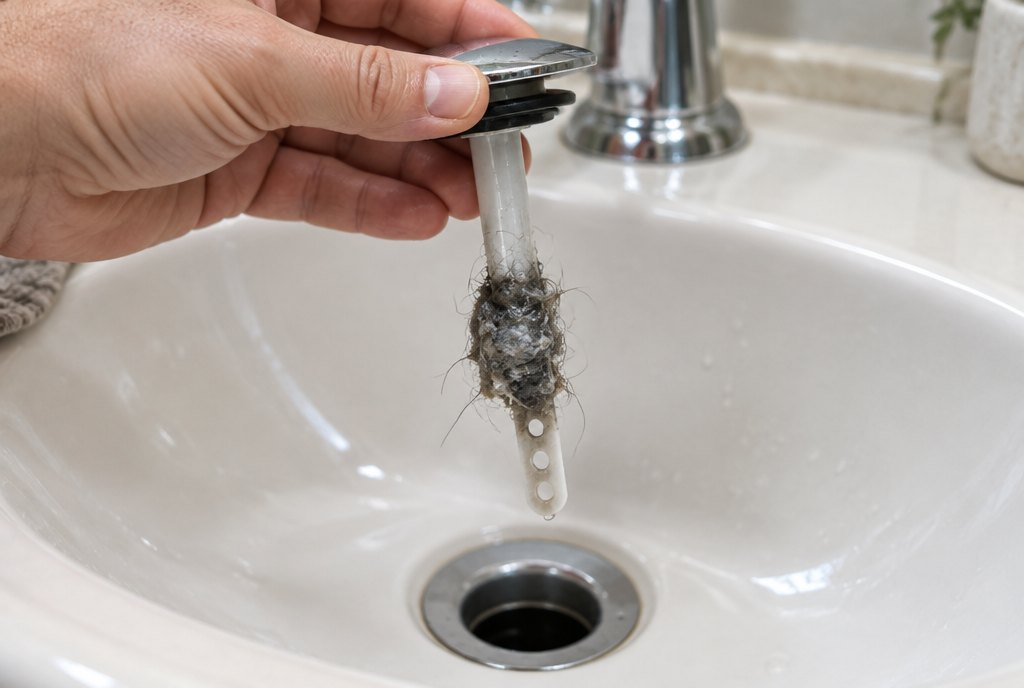
This is where to look first. Hair wraps around the stem of the pop-up stopper and the pivot rod just below it, soap and toothpaste glue it together, and the opening gets a little smaller every week. You usually cannot see it from above because the stopper cap hides it.
How to pull the stopper:
- Try lifting it first. Some stoppers are made to lift straight out for cleaning.
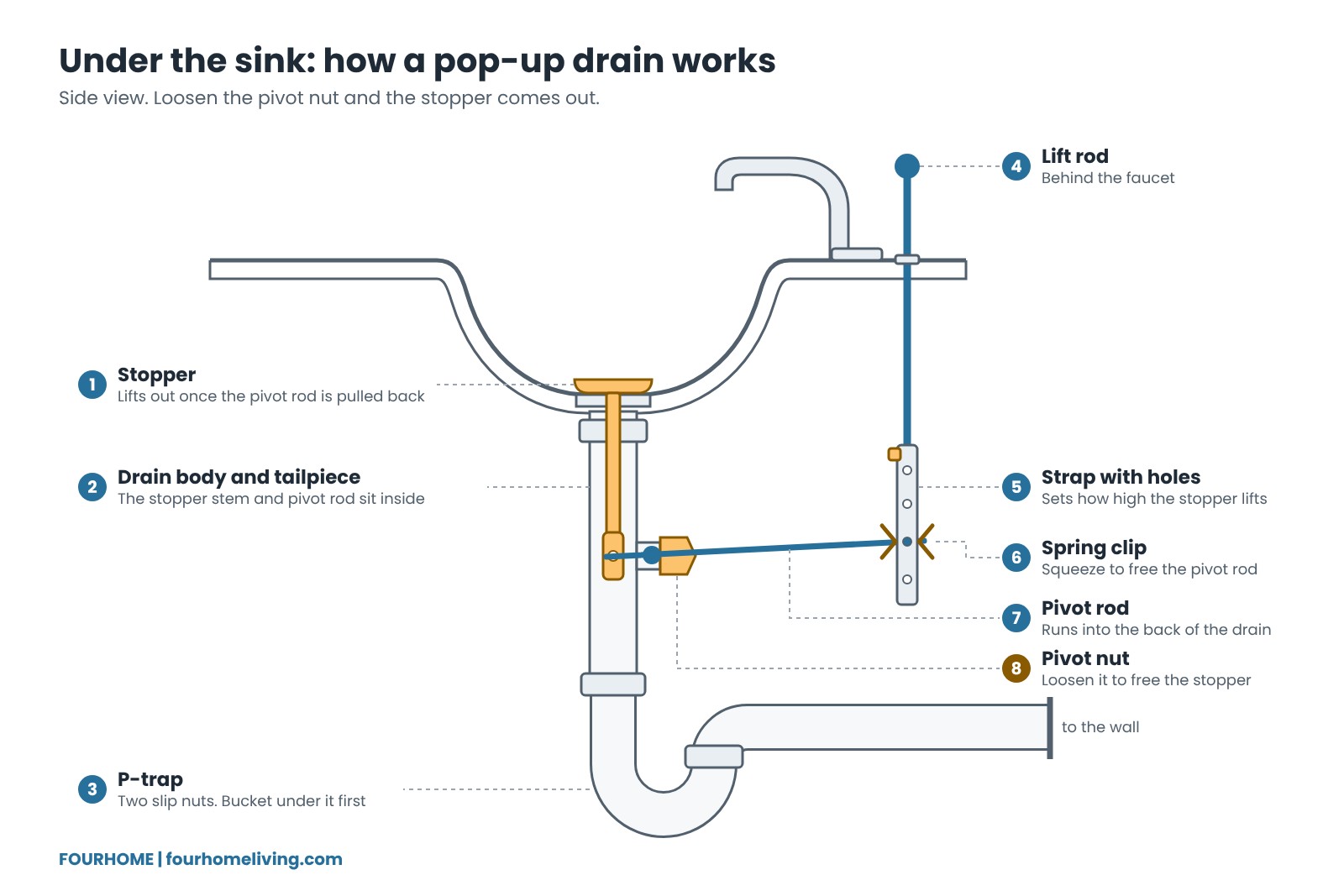
- If it will not come out, it is held by the pivot rod. Clear out the cabinet and look at the back of the drain pipe under the sink. A horizontal rod goes into the drain through a round nut. That is the pivot nut.
- Let the basin drain completely, then put a towel under the nut. Unthread the nut by hand, or with pliers if it is stiff, and pull the rod back an inch or two.
- Lift the stopper out from above and clean the stem. A plastic barbed drain strip or a bent wire pulls out what is left on the pivot rod and in the drain.
- Drop the stopper back in with the hole at the bottom of its stem facing the back of the sink, slide the rod through it, and thread the nut back on. Snug it by hand plus about a quarter turn. Over-tightening crushes the seal and starts a drip inside the cabinet.
- Close the stopper, fill the basin, then open it and watch the pivot nut while the basin empties. The stopper should open and close, and nothing should drip underneath.
Finish by running hot tap water for a minute. Hot from the tap is enough. Skip the kettle: PVC drain pipe is rated for a maximum of 140 degrees F, and boiling water is well past that.
Cause 2: The stopper is not lifting high enough
If the sink slowed down right after someone worked on the faucet or the drain, watch the stopper while you push the lift rod down. It should rise clear of the drain. If it barely lifts, the water has to squeeze past it.
The lift rod behind the faucet connects to the pivot rod through a flat metal strap with a row of holes, held by a spring clip. Squeeze the clip and slide it and the strap off the end of the pivot rod. Move the rod one hole at a time, clipping it back on each time, until the stopper lifts clear with the lift rod down and still seals with the lift rod up. The strap also slides on the lift rod where a small screw clamps it, which gives you a second adjustment. Kohler's support instructions describe moving the linkage to a different hole, and Moen's describe the strap screw.
Cause 3: A clog in the P-trap
The P-trap is the U-shaped bend of pipe under the sink. It holds a little water on purpose: that water is the seal that keeps sewer gas out of the room. It also catches whatever gets past the stopper, including the occasional earring.
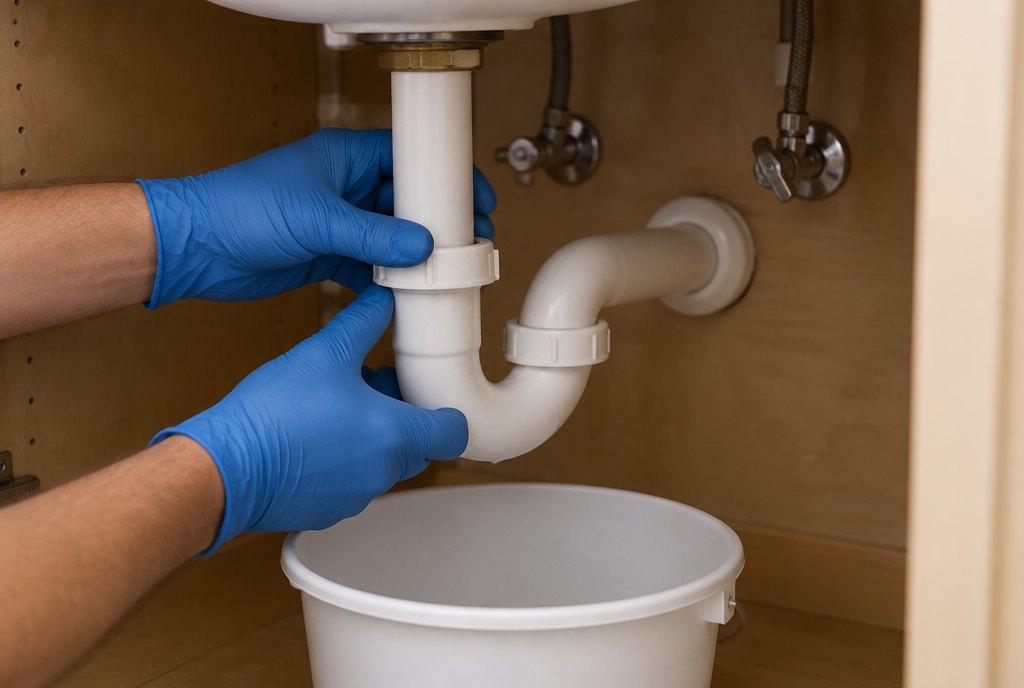
- Put a bucket under the trap. If any drain cleaner went down this sink, stop and go back to the warning at the top before you open anything.
- Loosen the two slip nuts, one at each end of the bend, by hand or with pliers, and lower the trap into the bucket.
- Clean it out with a bottle brush, and check the pipe ends on both sides for buildup.
- Put it back with the washers seated and snug the nuts by hand. Run water and watch each joint. If one weeps, tighten it a little at a time with pliers. Plastic slip nuts crack if you force them.
Running water at the end also refills the trap, which puts the sewer gas seal back. If the stopper and the trap are both clean, the stopper lifts fully and the sink is still slow, the clog is further down the line. Stop there and call a plumber.
Cause 4: A worn stopper or a tired pivot rod
Sometimes the parts themselves are the problem. A stopper that sits crooked, sticks halfway open, or has a cracked or corroded rim never opens fully and never seals fully either. The drain body is usually fine. The stopper is the part that wears out.
Measure the old one before you order. Our universal pop-up stopper is 5 in. long with a 1-3/8 in. stainless steel cap, sized for the common 1-1/4 in. pop-up drain body, and it reuses the pivot rod, ball and lift rod already under your sink. A three-hole strap at the base of the stopper stem sets the height so the stopper seals flush. It comes five to a box, enough for every sink in the house with spares on the shelf.


If your old stopper is shorter, about 3-5/8 in. long with a 1-3/16 in. cap, it may be the Pfister style. Compare both measurements with the replacement for Pfister 972-691A before you order. Push-button, click-clack and lift-and-turn stoppers have no rod under the sink at all and take a different part.
When the rod is the problem
If the lift rod moves but the stopper does not, first check that the spring clip is still on the strap and that the pivot rod passes through the hole in the stopper stem. If both are in place, or the stopper drops on its own, look at the pivot rod. A rod that is bent, rusted or worn at the ball cannot hold the stopper open. A weep at the back of the drain while a full basin empties points to the washer behind the pivot nut.
Our pivot rod kit renews the whole joint, not just the rod: a 6-1/2 in. chrome rod with a 5/8 in. ball, a brass pivot nut, a seat washer and a spring clip. The lift rod strap is reused from your drain. Measure your old rod end to end and expect close to 6-1/2 in.

Cause 5: The drain itself is worn out
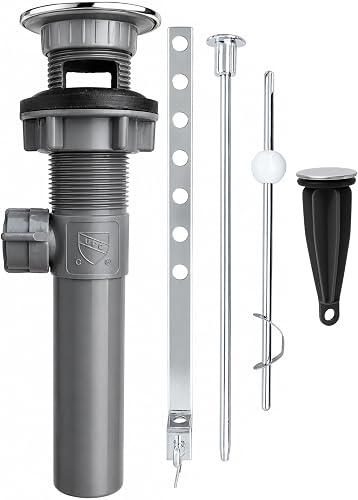
When the linkage has seized so the stopper cannot open fully, or the flange in the bowl is pitted and the tailpiece is cracked at the threads, cleaning and adjusting will not hold. Replacing the complete pop-up drain is a 20 to 30 minute job with adjustable pliers, a small wrench and plumber's putty (not in the box), and one box brings a new stopper, drain body, tailpiece and the full lift-rod linkage.
Check two things before you order: the bowl has a small overflow opening near the rim, and it is a standard bathroom sink that takes a 1-1/4 in. drain. Both drains below fit that sink. The difference is under the flange. One has a plastic body and tailpiece that will not rust, scale or pit in hard water. The other is cast brass from the flange down to the outlet and takes more wrenching at the locknut. The full walkthrough is in our pop-up drain guide.

When it is not the sink
If the tub and the sink are both slow or the drains gurgle, the likely cause is a clog past the trap or a blocked plumbing vent. Neither one is fixed from under the sink, and clearing a roof vent is not a homeowner job. Call a licensed plumber. Do the same if you smell sewer gas. Our sister site 247 Plumbers Nearby covers what to do about a main sewer line clog while you wait.
Drain cleaner, baking soda and boiling water
- Chemical drain cleaners. They can burn skin and eyes, they should never be mixed with any other product, and at least one label says never to use a plunger during or after use. On a bathroom sink the clog is almost always hair you can reach, so pull the stopper before you ever reach for a cleaner. If one is already in the drain, leave the stopper and the trap alone and follow the warning at the top of this guide.
- Baking soda and vinegar. It fizzes, but according to Poison Control the gas generally does not build enough pressure to push a clog out. It is not a fix. Never pour vinegar in after a chemical cleaner.
- Enzyme drain products. These are maintenance products, used on a schedule to keep a clear drain clear. They are not made to open a clog.
- Boiling water. Skip it. Hot tap water is enough, and boiling water is past what PVC drain pipe is rated for.
The ten-minute check
- Run the water and watch. Is it only this sink?
- Lift the stopper out. If it will not come out, loosen the pivot nut under the sink and pull the rod back.
- Clean the stopper stem and pull the hair off the pivot rod.
- Put it back, snug the nut by hand plus a quarter turn, and flush with hot tap water.
- Still slow? Clean the P-trap. Stopper crooked or worn? Measure it and replace it.
Start with the stopper and work down the list. The first three fixes need no parts at all.
Replacement pop-up stoppers, pivot rods and complete bathroom sink drains, plus cartridges and stems for the faucets already in your home, shipped from Amazon fulfillment centers with Prime delivery.
See the full FourHome assortment on AmazonFourHome is an independent brand and is not affiliated with Pfister, Moen or Kohler. Brand names and part numbers are used only to identify compatibility. If you have used a chemical drain cleaner, follow its label before you work on the drain. For sewer odor, several slow drains at once, or a leak inside a wall, call a licensed plumber.
Frequently asked questions
Why is my bathroom sink draining slowly?
Most of the time it is hair and soap scum caught on the pop-up stopper and on the pivot rod just below it. Pull the stopper, clean it, and the sink usually drains normally again. If the stopper is clean, check that it lifts high enough, then clean the P-trap.
How do I remove a bathroom sink stopper?
Try lifting it straight out first. If it will not come out, look under the sink for the horizontal pivot rod that enters the back of the drain. Unthread the nut that holds it, pull the rod back, and lift the stopper out from above. Put it back the same way and snug the nut by hand plus a quarter turn.
Can I pour boiling water or drain cleaner down a slow bathroom sink?
Use hot tap water, not boiling. PVC drain pipe is rated for a maximum of 140 degrees F. Chemical drain cleaners can burn skin and eyes and should never be mixed with other products. On a bathroom sink the clog is usually hair on the stopper that you can remove by hand, so try that before any cleaner. If a cleaner is already in the drain, do not pull the stopper, plunge the sink or open the trap. Follow the label, and call a plumber if the drain stays blocked.
Will a universal stopper fit my sink?
It fits pop-up drains worked by a pivot rod and a lift rod behind the faucet, on the common 1-1/4 in. drain body. Measure your old cap first: the FourHome universal stopper is 1-3/8 in. across and 5 in. long. Push-button, click-clack and lift-and-turn stoppers have no rod under the sink and take a different part.
When should I call a plumber?
Call a licensed plumber if more than one drain is slow, the drain gurgles, you smell sewer gas, or the sink is still slow after the stopper and the P-trap are clean. Those point to a clog further down the line or a blocked vent.
FourHome is not affiliated with or endorsed by any faucet manufacturer. Brand names and part numbers are used only to identify compatibility.