What a Pressure-Balance Shower Cartridge Does, and How to Tell If You Have One
You are in the shower, someone flushes a toilet, and the water does not turn scalding. That is the job of the pressure-balance cartridge inside many single-handle shower valves. Delta says its Monitor pressure balance valves are made so you do not get a sudden and possibly unsafe change in water temperature as a result of running water elsewhere, such as using a dishwasher, flushing a toilet or running a washing machine.
This guide explains what the cartridge does, what it cannot do, how it differs from a thermostatic valve, and which cartridge your valve takes. If you want the full picture of the valve in the wall, our sister site has a plain guide to how a pressure-balance shower valve works.
What a pressure-balance cartridge does
Your shower mixes water from two pipes, hot and cold. Each pipe has its own pressure, and other fixtures in the house pull on those pipes. When a toilet refills, the cold side can drop for a moment. Without anything to react, the mix at the showerhead would swing toward hot.
ASSE International, which writes the ASSE 1016 standard for these valves, defines a pressure-balancing valve as one that senses inlet supply hot and cold water pressures and compensates for variations in the inlet supply pressures. In plain words: when one side loses pressure, the cartridge holds back the other side so the mix stays close to where you set it. The makers say their valves hold the temperature within a few degrees.
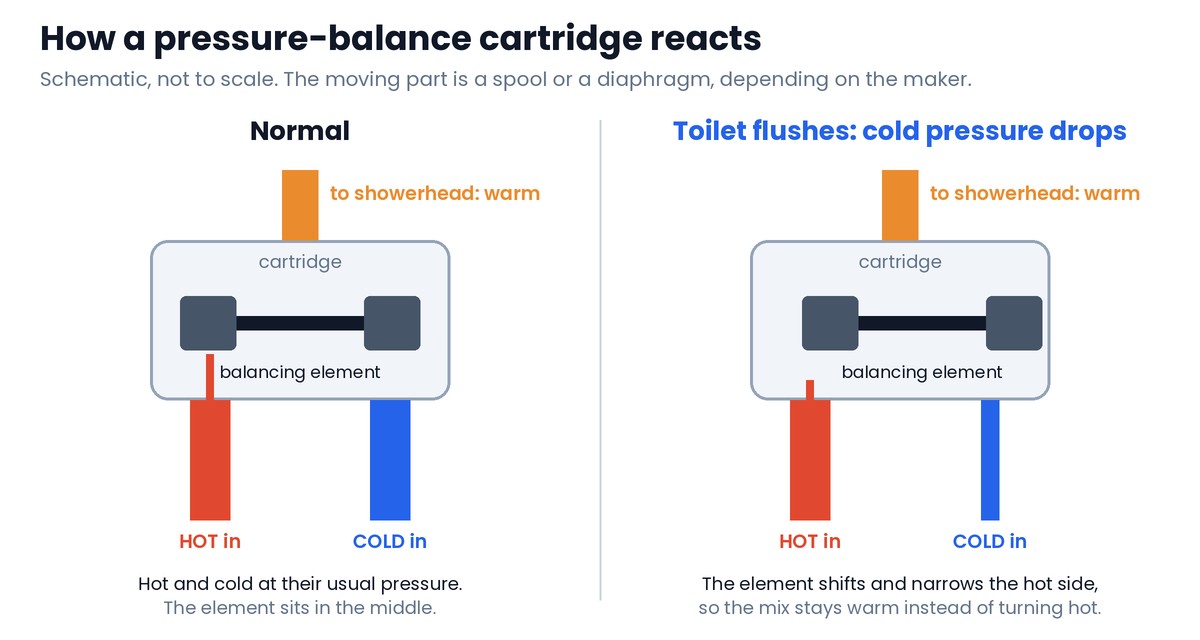
What moves inside depends on the maker. Moen names a 1423 balancing spool in its Moentrol valve. Pfister calls the part in its 0X8 valve a spool balancing unit. Kohler describes Rite-Temp as a pressure-balancing diaphragm design, with a one-piece diaphragm cartridge. Delta's MultiChoice owner's manual gives a simple check for its pressure balance unit once the cartridge is out: turn it to the full mix position and shake it. If there is a rattling sound, the unit is functional, and if there is no rattle, Delta says to replace the housing assembly.
What it cannot do
A pressure-balance cartridge reacts to pressure, not to temperature. Watts, a valve maker, puts it directly in a document on ASSE 1016: Type P valves cannot compensate for changes to incoming supply temperatures. Delta's MultiChoice manual says the same about its own valve: this valve does not automatically adjust for inlet temperature changes.
So if your water heater runs cooler, or the cold water coming into the house is colder in winter, a pressure-balance shower will feel different even though nothing is broken. Delta says its Monitor valves may need to be manually adjusted for seasonal ground water temperature changes. If the shower only started running lukewarm when the weather turned, read our guide to a shower not getting hot in winter before you buy a part.
Pressure balance or thermostatic?
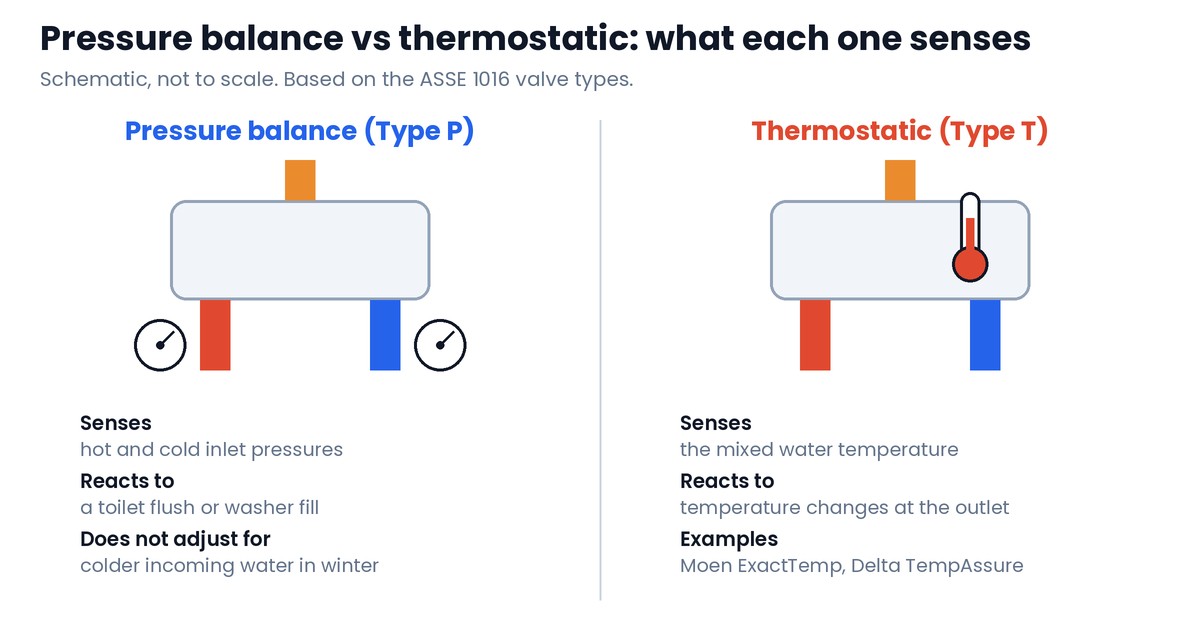
ASSE 1016 covers three kinds of shower valve. A Type P valve balances pressure. A Type T valve, thermostatic, senses the water temperature at the outlet and compensates for thermal variations. A Type T/P valve compensates for both pressure and temperature changes.
| Pressure balance (Type P) | Thermostatic (Type T) | |
|---|---|---|
| What it senses | Hot and cold inlet pressures | Water temperature at the outlet |
| Toilet flush or washer fill | Reacts to the pressure change | Reacts to the temperature change |
| Colder incoming water in winter | Does not adjust on its own. Delta says the limit stop may need a seasonal adjustment | Delta says its TempAssure valve reads water temperature to adjust for seasonal ground water temperature changes |
| Example | Moen Posi-Temp (1222), Delta 13 and 14 series (RP46074), Kohler Rite-Temp (GP500520) | Moen ExactTemp, Delta TempAssure |
Do not go by the number of handles alone. Moen's ExactTemp thermostatic system pairs a thermostatic valve with a separate volume control valve. But Moen's Moentrol valve, which pulls out for volume and turns for temperature, is still a pressure-balancing valve, and Delta lists its 17 series as a dual function pressure balance valve with volume control. Delta also says TempAssure thermostatic valves are only available for dual-function tub and shower faucets.
What the code says
The 2021 International Plumbing Code, section 412.3, says individual shower and tub-shower combination valves shall be balanced-pressure, thermostatic or combination valves that conform to ASSE 1016/ASME A112.1016/CSA B125.16 or ASME A112.18.1/CSA B125.1. The same section requires a means to limit the maximum setting of the valve to 120 degrees F (49 C), which shall be field adjusted. The International Residential Code has the same rule in section P2708.4. Your city or state adopts its own edition and may change it, so check with your local building department before a remodel. That last line is our own advice.
The limit stop is part of the safety
A white paper from ASSE International, hosted by IAPMO, defines the limit stop as an adjustable and lockable means to limit the maximum setting of a device towards the hot position, and notes it may be set lower at the homeowner's preference. Moen recommends limiting the maximum temperature flowing from the shower to 120 degrees F (49 C) or less to prevent scalding. Delta says someone must make the rotational limit stop adjustments at the time of installation.
Delta says to note the position of the rotational limit stop on the cap before removing the cartridge, so you can set it back the same way. Shut off the water to the shower first. Moen says the water supply shut off valves must be turned off before a 1222 swap, and that if the retainer clip cannot be put back or is damaged, the water cannot be turned back on until the clip is replaced. The U.S. Consumer Product Safety Commission notes that a water heater setting of 120 degrees F may be necessary to reduce or eliminate the risk of most tap water scald injuries, and that most tap water scald injuries and deaths involve the elderly and children under the age of five. After any cartridge change, test the hottest setting before anyone showers. That last step is our own advice.
Which cartridge does your valve take?
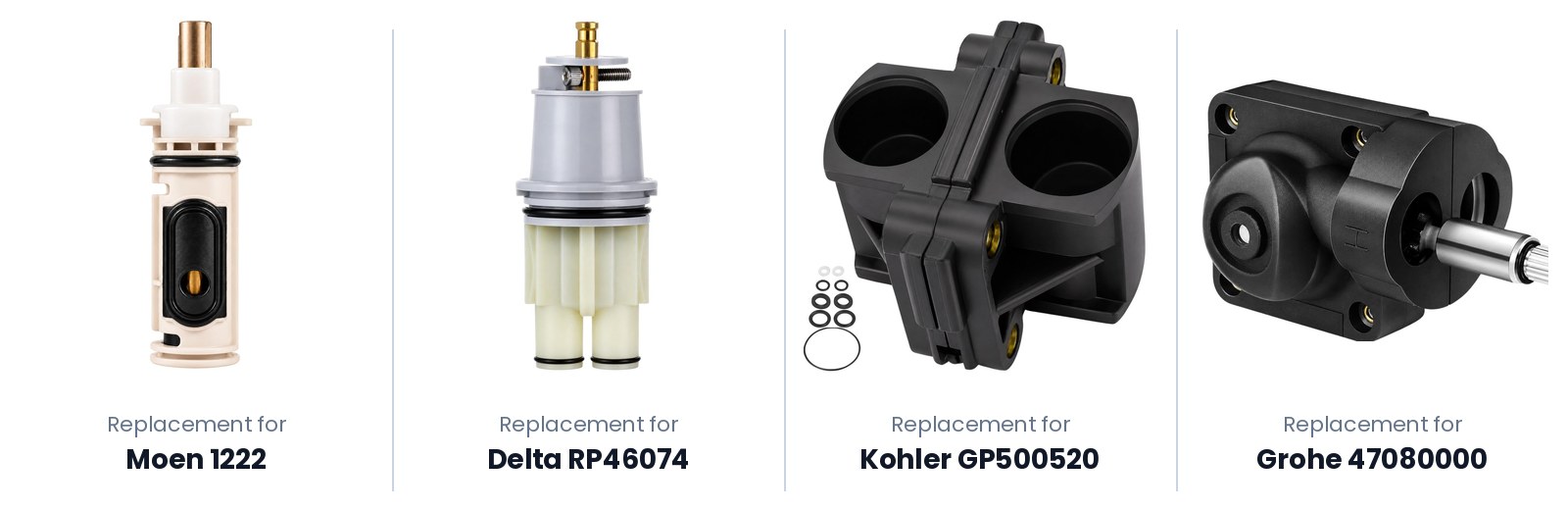
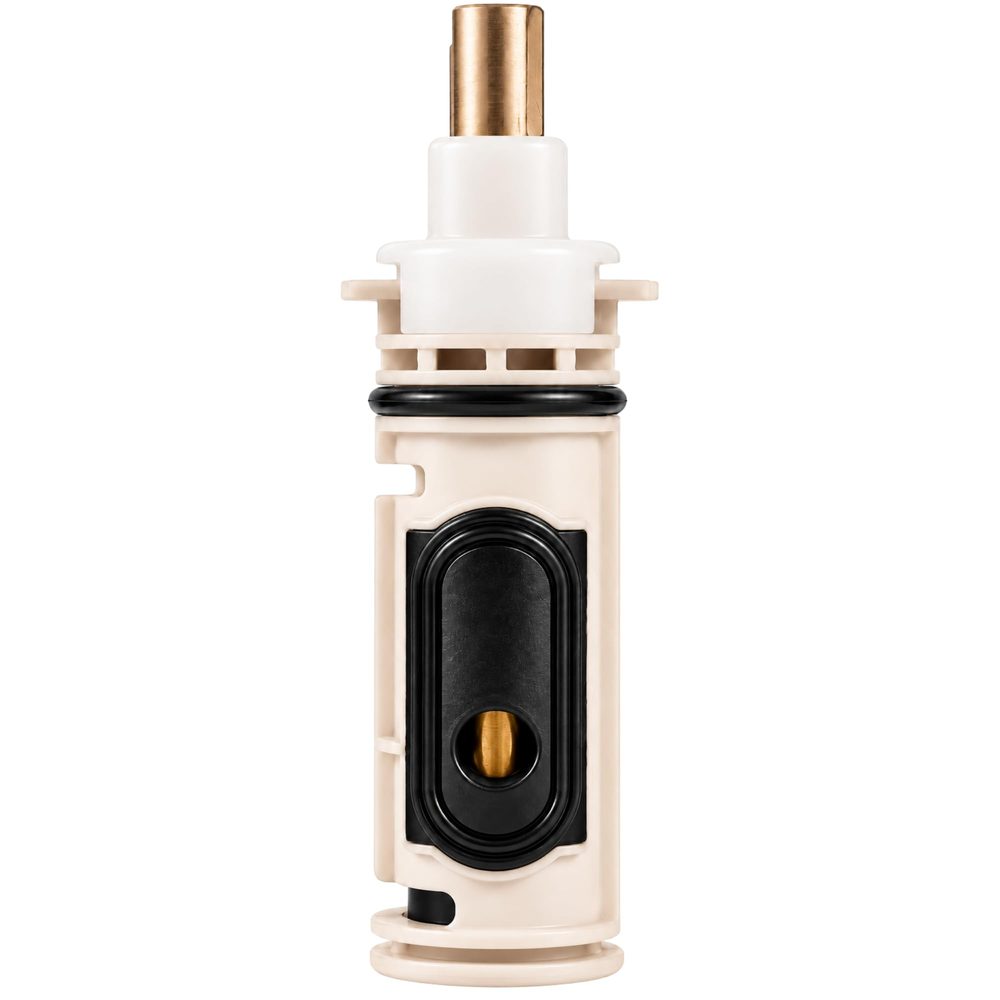
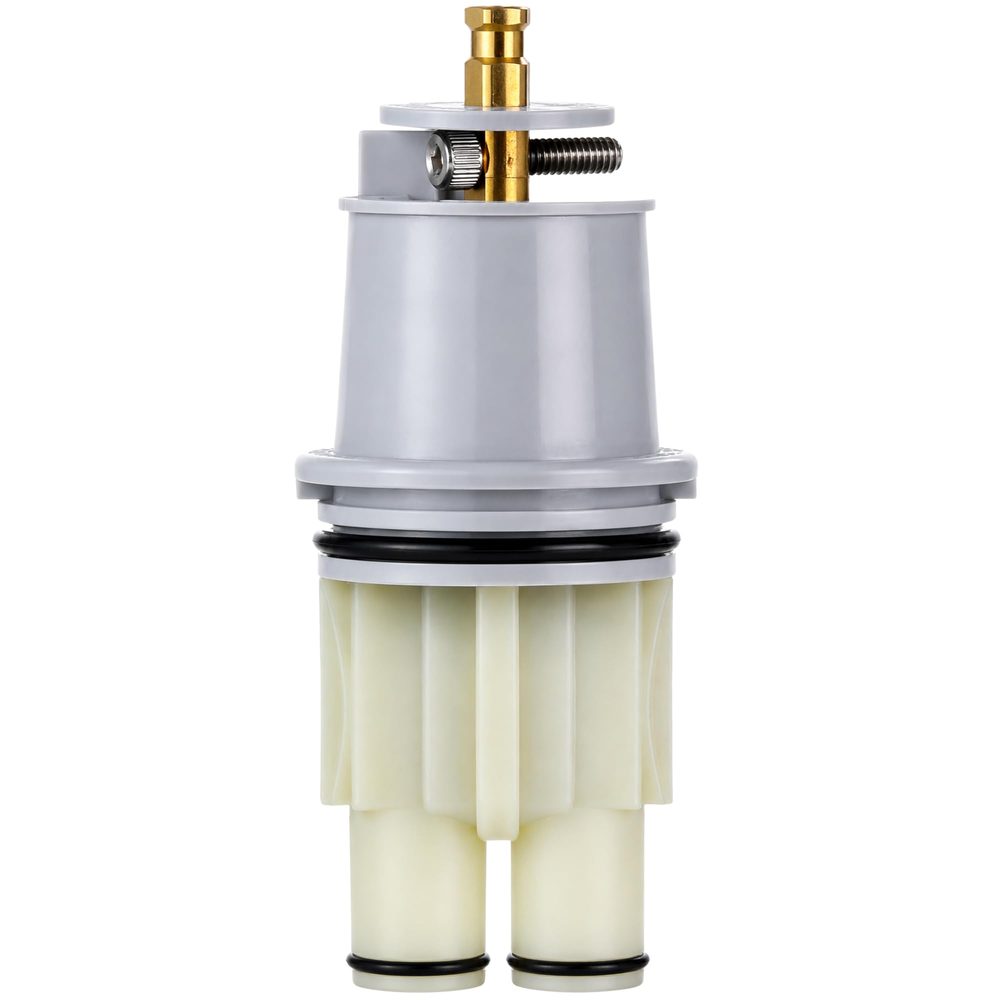
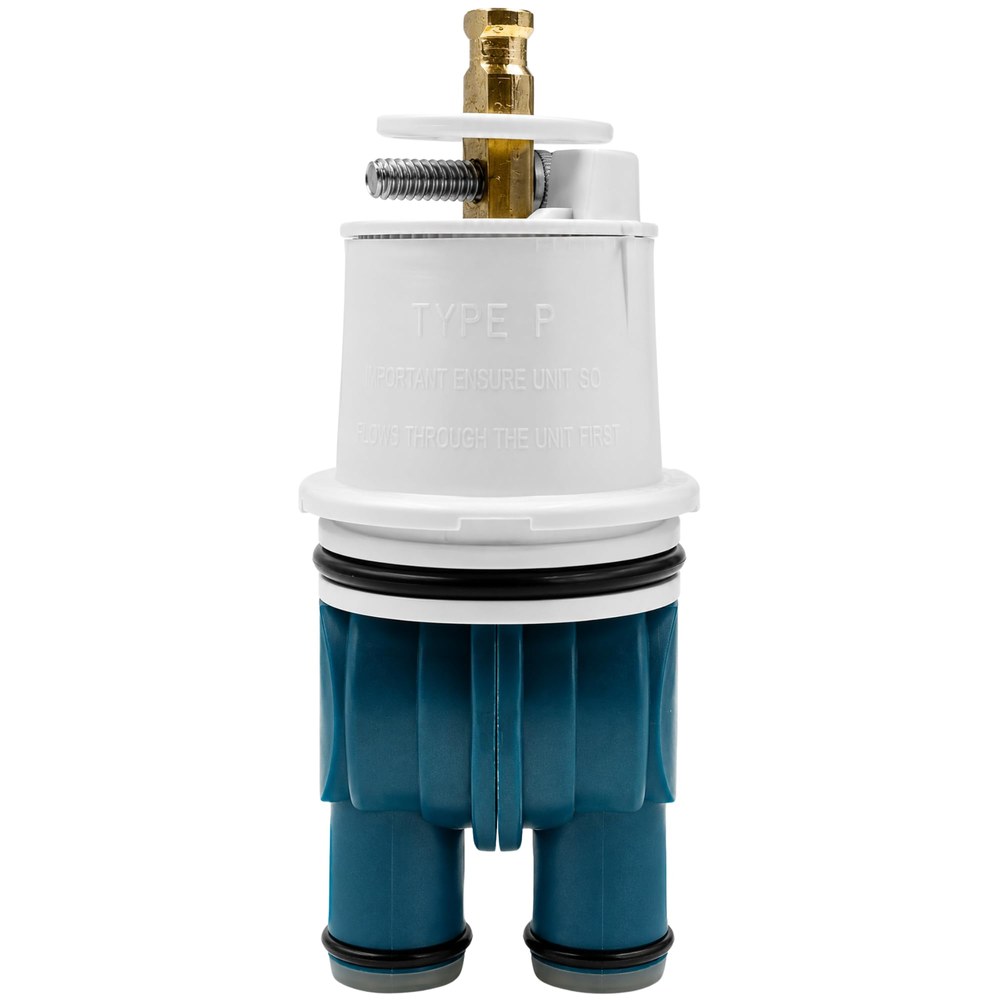
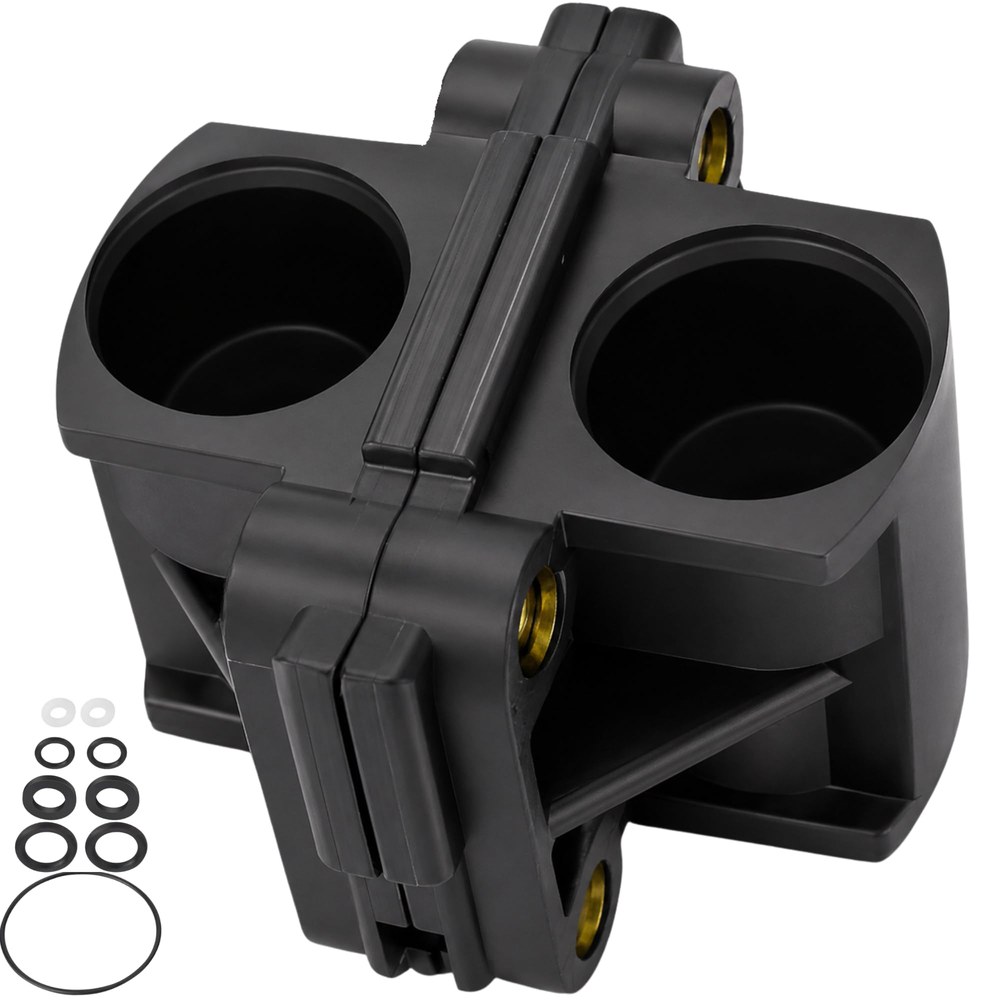
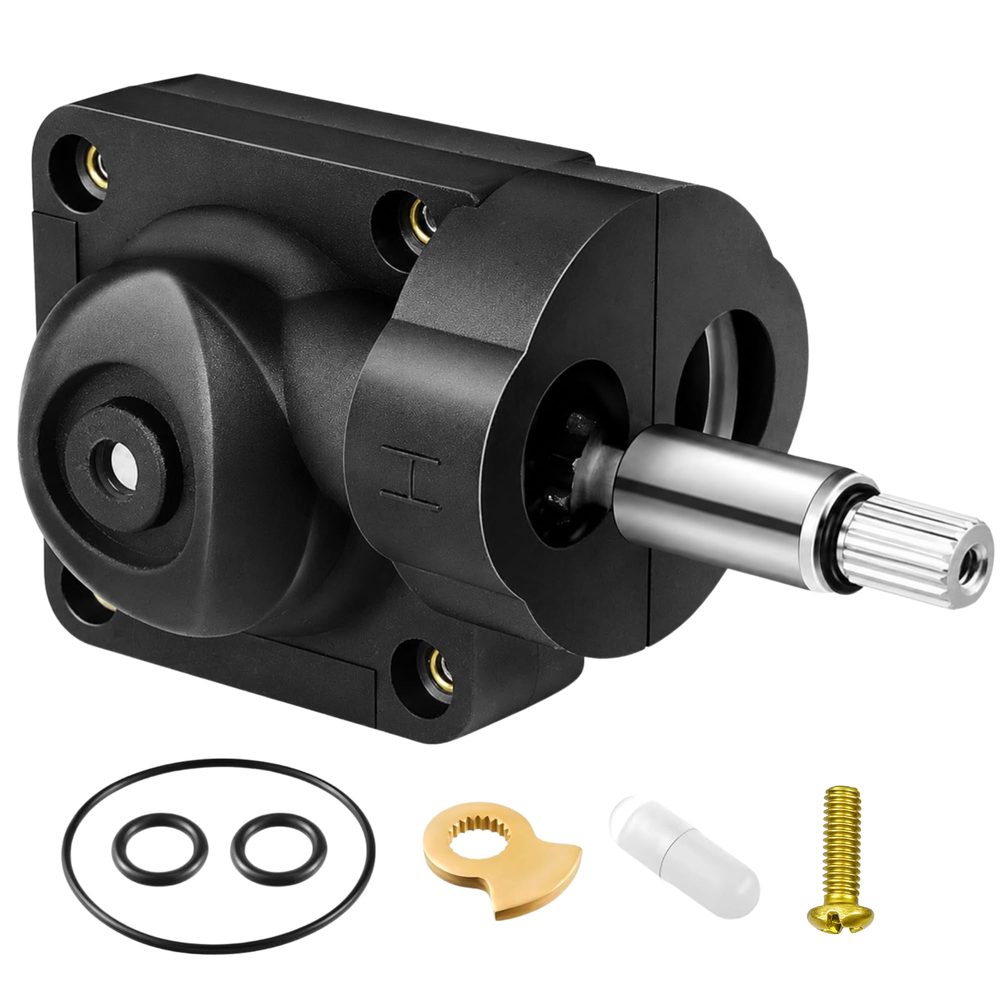
Each cartridge below is made for one maker's valve, so match by brand and part number. Delta even says its two Monitor cartridges below are not interchangeable with each other. Use the table to find yours, then match the old cartridge in your hand before you order. Our cartridge identification guide shows what to look for.
| Your valve | Maker cartridge | FourHome replacement |
|---|---|---|
| Moen Posi-Temp: one handle that turns from cold to hot | Moen 1222 | Replacement for Moen 1222 |
| Delta MultiChoice 13 and 14 series, made after March 2006 (per Delta) | Delta RP46074 | Replacement for Delta RP46074 |
| Delta Monitor 1300 and 1400 series, made up to early 2006 (per Delta) | Delta RP19804 | Replacement for Delta RP19804 |
| Kohler Rite-Temp K-304 | Kohler GP500520 pressure balancing unit | Replacement for Kohler GP500520 |
| Pfister valves stamped 0X8, JX8, VB8 or JV8 | Pfister 974-042, now 974-5299 | Replacement for Pfister 974-042 |
| Grohe 35 000 series pressure balance valve | Grohe 47080000 | Replacement for Grohe 47080000 |
Valve families from the makers: Moen spec sheets list a 1222 cartridge design for Posi-Temp valves; Delta's RP46074 and RP19804 pages; Kohler's K-304 service page names the GP500520 the pressure balancing unit; Pfister's 974-0420 page lists the 0X8, JX8, VB8 and JV8 valves and marks 974-042 replaced by 974-5299; Grohe lists 47080000 as the pressure balance valve cartridge for its 35 000 series. Delta gives two cut-off dates for the 1300 and 1400 series on the same page, before March 2006 and April 2006 and earlier, so go by the cartridge in your hand, not the date.
Signs the cartridge is wearing out
These are the makers' own troubleshooting notes.
- Moen lists a stuck balancing spool among the causes of water that is not hot enough, and says that on a Posi-Temp valve, if the water pressure decreases when going from cold to hot, the 1222 cartridge would need to be replaced.
- Moen lists low flow on the hot or cold side, or low flow at both the tub spout and the showerhead, as a reason to replace the 1222. For low flow at the showerhead only, Moen says to check the showerhead's flow rate.
- Delta's MultiChoice manual lists unable to maintain constant water temperature as a reason to replace the cartridge housing with the RP46074 (or work through the manual's helpful hints first), and a drip from the showerhead that continues after new seats and springs as a reason to replace the RP46074.
- Kohler says a drip from the showerhead or spout on a Rite-Temp valve could be an internal seal or tear, and its fix is the mixer cap and pressure balancing unit kit.
- Delta notes that if your water has lime, rust, sand or other contaminants, a pressure balance valve will require periodic inspection.
Our guide to five signs your shower cartridge needs replacing walks through each symptom, and our Moen 1222 replacement guide and Delta Monitor guide cover the swap step by step.
In its note on stiff handles, Moen says to use a silicone-based grease and not plumber grade faucet grease, silicone sprays or any lubricant that may contain petroleum, because petroleum-based lubricants may react with the rubber seals. Kohler says only silicone based lubricants should be used with its Rite-Temp valves. Moen also says it is highly recommended to clean and flush the valve body before installing a new 1222.

When to stop and call a plumber
Each of these is our own advice, not a maker rule.
- The water never gets warm, or never gets cold, after a new cartridge and a check that the handle is on the right way. Moen says a handle on upside down will not rotate the cartridge properly.
- The temperature still swings with a new cartridge in place. The problem may be in the supply, the water heater or the valve body.
- The old cartridge will not come out with the tools your maker recommends, or the valve body is damaged. Do not force it.
- You are remodeling and replacing the valve itself. That work is inside the wall and falls under your local code.
Frequently asked questions
What does a pressure-balance shower valve do?
It keeps the shower temperature steady when the pressure on the hot or cold supply changes. The ASSE 1016 standard describes this type as a valve that senses the hot and cold inlet pressures and compensates for changes in them, and Delta says its Monitor valves guard against a sudden temperature change when someone runs a dishwasher, flushes a toilet or runs a washing machine.
Is a pressure-balance valve the same as a thermostatic valve?
No. Under ASSE 1016 a pressure-balancing valve reacts to inlet pressure, a thermostatic valve senses the water temperature at the outlet, and a combination valve does both. A pressure-balance valve cannot correct for a change in the temperature of the incoming water, which is why Delta says its limit stop may need a seasonal adjustment.
Does code require a pressure-balance valve in my shower?
The International Plumbing Code and the International Residential Code both say individual shower and tub-shower valves shall be balanced-pressure, thermostatic or combination valves, with a means to limit the maximum setting to 120 degrees F (49 C). Your city or state adopts its own edition, so ask your local building department if it matters for a remodel.
How do I know if my shower has a pressure-balance cartridge?
Read the brand on the trim and the number on the cartridge or valve. A Moen Posi-Temp valve uses one handle that turns from cold to hot and holds a 1222 cartridge. Delta 13 and 14 series valves made after March 2006 use the RP46074 pressure balance cartridge, and older 1300 and 1400 series valves use the RP19804. Separate volume control does not prove a valve is thermostatic: Moen Moentrol and Delta 17 series valves let you set volume and temperature separately and are still pressure balance.
What grease should I use on a pressure-balance cartridge?
Silicone. Moen says to use a silicone-based grease and not plumber grade faucet grease, silicone sprays or any lubricant that may contain petroleum, because petroleum may react with the rubber seals. Kohler says only silicone based lubricants should be used with its Rite-Temp valves.
Sources
The facts above come from these pages, except where a line says the advice is our own. We opened each one on October 12, 2026. Retailer-hosted copies are used only where they carry a maker document.
- ASSE International (hosted by IAPMO), Adjustment of Automatic Compensating Valves to Prevent Potential Scald Hazards (Type P, T and T/P, the limit stop definition).
- Watts, Automatic Compensating Valves for Individual Showers and Tub/Shower Combinations (Type P cannot compensate for supply temperature changes).
- International Code Council, 2021 IPC section 412.3; International Residential Code section P2708.4 as adopted in S.C. Code Regs. 8-1243.
- Moen: Posi-Temp and Moentrol, adjusting the Posi-Temp limit stop, water not hot enough, low flow, Posi-Temp, no warm water, handle is difficult to operate, how ExactTemp works, 1222 cartridge replacement and the Posi-Temp valve spec sheet.
- Delta: RP46074, RP19804, Monitor 14 series trim, Monitor 13 series trim, Monitor 17 series trim, TempAssure and Monitor valves and the MultiChoice valve trim owner manual.
- Kohler: K-304-K Rite-Temp spec sheet, K-305 spec sheet, K-304 and K-305 installation and care guide, K-304 service part instructions and Rite-Temp dripping.
- Pfister: cartridge 974-0420 and 0X8 rough-in valve. Grohe: pressure balance valve cartridge 47080000.
- U.S. Consumer Product Safety Commission, Avoiding Tap Water Scalds.
Replacements for Moen 1222, Delta RP46074 and RP19804, Kohler GP500520, Pfister 974-042 and Grohe 47080000, plus stems and cartridges for Moen, Delta, Kohler, Pfister and more, shipped from Amazon fulfillment centers with Prime delivery.
See the full FourHome assortment on AmazonFourHome is an independent brand and is not affiliated with Moen, Delta, Kohler, Pfister, Grohe, ASSE, IAPMO, the International Code Council, the CPSC or the other publishers cited. Brand names and part numbers are used only to identify compatibility or to cite their published instructions. Shut the water off first, do not force a cartridge, and call a licensed plumber for anything beyond a cartridge swap.
FourHome is not affiliated with or endorsed by any faucet manufacturer. Brand names and part numbers are used only to identify compatibility.